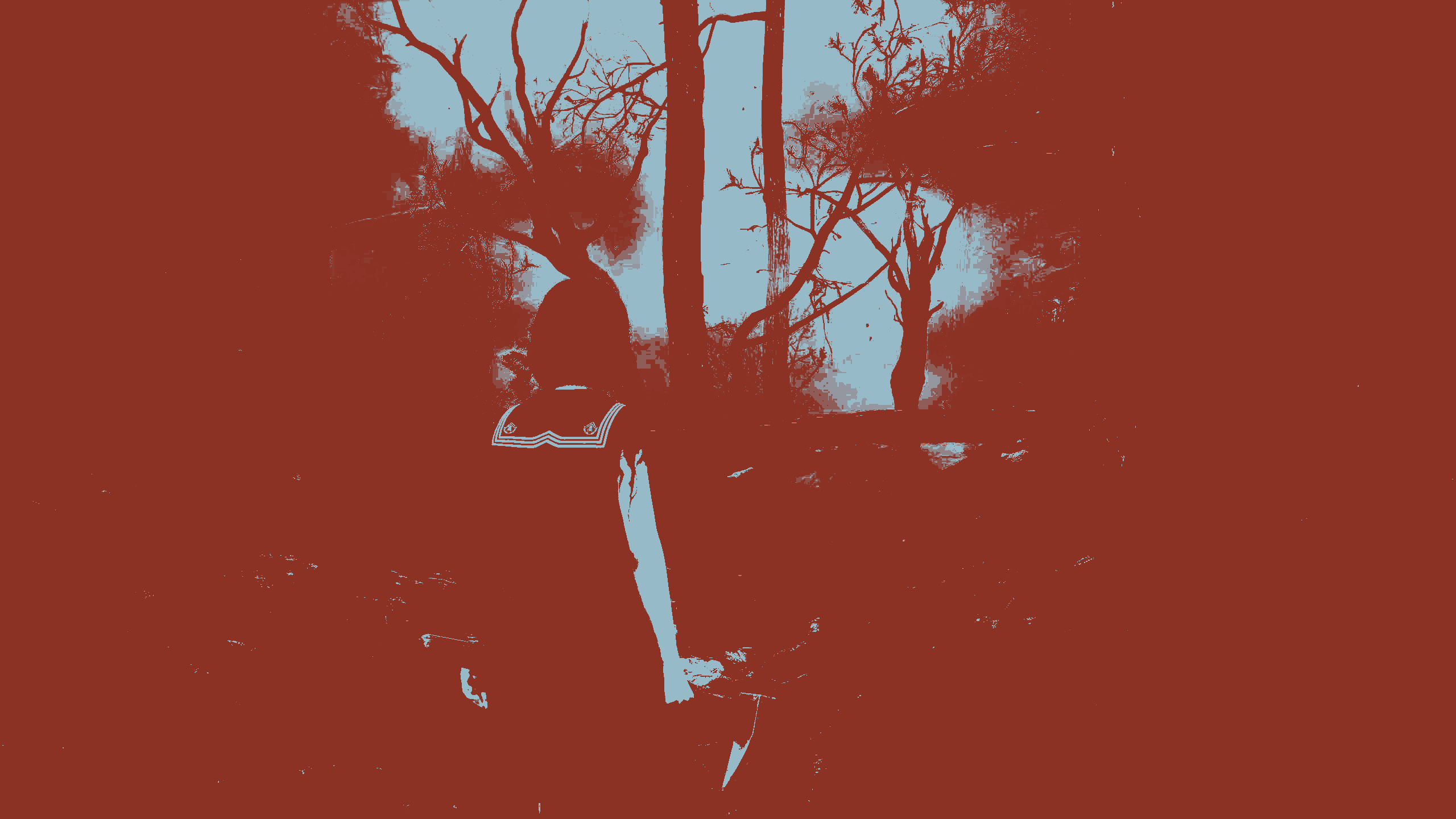
This article discusses plot details from throughout Silent Hill f.
In all of the Silent Hill games, the creatures you encounter represent—to varying degrees of abstraction—the neuroses, traumatic experiences, and other psychological defecta of the playable protagonists. Harry Mason is trying to find his missing daughter, so he goes to a school and gets attacked by a monster which, in one of the game’s official guidebooks, is literally called Child. Heather Mason is a teenaged girl and would-be incubator for the Gillespie cult’s embryonic god; Silent Hill 3 is thus populated by creatures bearing phallic, yonic, or fallopian resemblance. Silent Hill 2’s monsters are grotesques of James Sunderland’s guilty prurience. But the metaphorical or symbolic qualities of all these creatures are contradicted by, or in some kind of aesthetic tussle with, the singular, blunt-force way you interact with them. They represent something emotional, cognitive, or ‘inner’, but they are dealt with like every other type of videogame enemy, that is, by hitting them or shooting them. If their designs are invitations to some kind of inspection of the protagonist, or symbols of the protagonists’ own introspection, or, especially in the case of James Sunderland, their suppression of the inner self, their behaviours and how we behave towards them in response are simple by comparison. This monster represents grief. You can kill grief by shooting it three times with a rifle, or using a charged attack with the axe.
But at least in the original three Silent Hill games—the games inherently most responsible for creating and defining the series’ identity, and which the majority of latter Silent Hills are seemingly designed to emulate—the various combat systems and mechanics are accented by some degree of metaphor and symbolism. If the combat in these games represents an ineffable, psychological battle—James at war with the figurative demons within himself—some of the minutiae of that combat is, suitably, ‘unspoken’ or unarticulated. Combat in a videogame is traditionally highly readable. You have a health bar. The enemy has a health bar. You can see your weapon stats (ammunition, durability) somewhere on the screen. There are visual indicators for when an enemy is about to attack and similar prompts for you to launch your own counter attack. It may be difficult but it’s intelligible—even the hardest bosses in Dark Souls have life gauges, attack patterns, ‘cycles’, etc. By contrast, the combat in the original trio of Silent Hill games is notable for and characterised by the absence of these typical clarifiers. There are no ammunition counters. If you want to know how close you might be to death, you have to manually enter the inventory menu, and even there, the character’s health is represented not by a comprehensible bar, but a still image from the game in progress, the hue of which variates depending on the character’s remaining vitality—dull green to denote full strength, deepening shades of orange and red as they inch nearer to death. Enemies don’t have health bars at all. There are no extraneous indicators that telegraph their attacks. They do have patterns and routines—it is possible to ‘read’ them—but the long-lens, fixed-camera perspective typical of the early Silent Hill games and the incipient survival horror genre make that ‘reading’ less precise.
While fighting the symbol-heavy monsters in the early Silent Hills is ultimately a crude process of shooting and beating, it’s nevertheless accentuated by some degree of abstraction. The murky, contradictory, and complex psychological ordeals of the characters is reflected, to an extent, in the obscurities of the combat system, obscurities that are emphasised when Silent Hill is compared to other videogames. Even the older Resident Evil games, where there are also no on-screen markers of any kind, are, relative to Silent Hill, easy to read. If your character in Resident Evil 2, 3, Zero, or Code Veronica is wounded, they will start to limp, a warning that their health is low, equivalent in comprehensibility to a blinking meter. The very first game doesn’t have the limping animations, but still, as would become part of the Resident Evil mechanics language, when you open the inventory menu to check Chris or Jill’s status, it will tell you directly whether things are ‘FINE’, whether you should exercise ‘CAUTION’, or whether you are in ‘DANGER’. The combat systems in the formative Silent Hill games—and the systems tangential to combat—are distinctive for their lack of such clarity. That lack of clarity can be interpreted as a partial metaphor for the difficult-to-express inner pains of the playable characters, inner pains that are also symbolised in the monsters they engage in combat.
Silent Hill f is perhaps more rooted in metaphor and abstraction than any of the other games in the series—barring the deliberately absurd UFO ending, at the conclusion, it is revealed that everything that has happened has been part of an elaborate delusion, a protracted, trauma-induced vision quest, of sorts, wherein Hinako is attempting to reconcile, in a fantasy world, the horrors of her real life. The border between reality and the unreal is normally porous and ill-defined in Silent Hill and it is not always possible to separate the tangible from the metaphorical, or the subjectively conjured; f establishes that everything is metaphor, and thereby characterises the majority of the game’s events as inventions and abstractions. As you play Silent Hill f, you are playing through the character’s intangible inner life.
But the language and functions of the combat are much clearer and defined than other Silent Hill games. There is a health bar. There are markers to indicate incoming attacks. Weapons have a durability meter. You have access to a distinctive variety of offensive and defensive maneuvers, each of which are explained to you in written tutorials, tutorials that you can access again from the inventory screen. It is a coherent, apprehensible, and directive combat system, designed to exclude ambiguity. The broader events and world of Silent Hill f may function via the oxymoronical ‘nightmare logic’. The combat, by contrast, functions by a strict and generalised videogame logic–traditional mechanical logic. It’s not only a combat system but a combat system familiar to other videogames. Even though aesthetically and narratively Silent Hill f is couched in the subjective experiences of its protagonist, something which is made abundantly clear both in the ending (it was all happening inside her mind) and, in series’ tradition, many of the environmental and monster designs (Hinako is forced into an arranged marriage reflective of a suffocating, patriarchal society; she fights living dolls, and creatures made entirely out of swollen, pregnant abdomens, which recurrently give birth to more dolls), the language of the game’s combat mechanics is ‘objective’. The game presents a kind of emotional and empathetic challenge to the player to attempt to understand Hinako’s suffering, suffering that is personalised to her. But in the actual playing, although there may be some level of ludic challenge, i.e. you might get killed in some of the boss fights, there is nothing to stimulate or appeal to your willingness to empathise. The design of the combat is such that you could be controlling a number of other videogames or videogame protagonists. Moreover, the design is straightforward, telegraphed and lucid in a way that contradicts the–quite literally–dreamy abstractions that are layered into the game elsewhere.
Perhaps this could be interpreted in a different way. Rather than an inconsistency in the language and design of Silent Hill f, perhaps it could be argued that the clarified and familiarly systematic, readable combat mechanics represent a conflict within Hinako—although a part of her has collapsed, or is close to collapsing, into frantic, nightmarish delusion and psychosis, there is another part that is fighting to maintain a tangible sense of self, or sense of something. The mismatch between the rationality and the empiricism of the combat and the abstraction and illogic of the rest of the game world symbolises Hinako’s true and firmly held sense of self battling against the madness and the terror thrust upon and now threatening to overwhelm her. The problem with that interpretation, however, is that the broader design of Silent Hill f also often relies on concrete, coherent videogame grammar, pseudo-puzzle sections where you must collect three items to insert into three hollows or turn levers in the correct combination to open a door. More generally, the game has a strongly defined and straightforward structure, a regular meter whereby you will alternate between an hour of gameplay in Ebisugaoka and then an hour in the world of Fox Mask. This isn’t ‘predictable’ in the dismissive or qualitative judgement sense, as in, ‘there is nothing in Silent Hill f that might surprise you’. But it is predictable in the sense that you can reliably expect it to happen, which unsettles the interpretation of Silent Hill f as a game about order—Hinako’s innermost and most dearly held sense of her true independent self—in a fight against disorder—the emotional and cognitive breakdown that is threatening to overwhelm her.
But perhaps there is a third interpretation. If the organisation and readability of the combat system reflects the strength of Hinako’s personality, that is, the clarity and the passion with which she understands what she truly wants, then maybe there is something similar to be said about the general structure of Silent Hill f. Maybe the highly mechanical and routine puzzles, the ‘find-three’ level design and the clockwork alternations between Ebisugaoka and Fox Mask world symbolise the social ordering and the systems of belief with which she is in conflict. What you have is a young woman who knows what she actually wants and what she wants to be— she is independent, and wants to stay independent. Those characteristics are represented in Silent Hill f’s combat systems; like Hinako, who is deeply aware of what she is fighting for, when we fight in the game, there is no ambiguity. And what she, and us as her, are fighting against is similarly immutable, defined and systemic; if Silent Hill f has a rigid macro structure, perhaps that is to reflect the rigid macro social structures that are threatening to push Hinako into the arranged marriage and the subservient life that attends. Maybe what you have, rather than a game where the intelligibility of the mechanics misaligns with the aesthetic or narrative abstractions, is a game manifested in two types of order: the order of the mechanics and the order of the levels and meta design, and the thrust of the whole thing is how those orders collide, and then that becomes symbolic of how a person, with a defined sense of their individual identity, comes into conflict with an equally delineated and impressive social rule.
Except … the combat and the broader, Ur-design complement and flow into one another. The levels are built as stages for combat encounters and the combat encounters are fundamental to progressing the levels. There isn’t substantial friction between the two. Friction might not be a ‘necessary,’ Platonic quality of a ‘good’ videogame, but there are, throughout Silent Hill f, some wonderful examples of Hinako experiencing friction, sometimes between her sane self and her insane self and other times between herself and the society in which she has been raised. By contrast, the process of playing the game, as Hinako, is generally fluid. The world and the systems are all legible. The game is ‘about’ being disempowered and passive (or at least the possibility of becoming those things) but you have weapons, upgradeable abilities and reams of heads-up information, all signifiers of, and aids to, strength and action.
Oh, but even then, it’s not that simple, because there are parts of Silent Hill f that seriously do impress the pain and the struggle, and the friction (which feels like too small a word here) of Hinako’s experiences. Yes, it might be quite straightforward to play and all unobfuscated by design, but Hinako still gets cut to ribbons by the enemies, and we see the marks that have been left on her. Her clothes rip and her skin tears and whenever we’re in combat, even if we do have an axe with a charge attack, and a legible counter system, our protagonist still screams and struggles, and we can hear her trying to heave the axe like it weighs more than she does. We still have the scene, the incredible scene, where, mystified and bewitched by the circuitous world of Fox Mask, she submits to being physically deformed–to deforming herself—in a perverse, willing-and-unwilling blood tribute to the society to which she belongs. And if we’re talking friction, in the Game Design 101 sense of the word, the fact you have to finish Silent Hill f multiple times and in multiple styles to fully access and therefore comprehend the end of Hinako’s story must surely qualify. Our protagonist is struggling to make sense of herself and her role in her world. If we also want to understand what’s going on, both within and without Hinako, we have to make a consonant ‘effort’, and go through a kind of ardour of playing. And it’s not like a character’s inner conflict can only and should only be represented by mechanical friction. Just because Silent Hill f is very playable, that doesn’t mean that its central character can never be convincingly complex or in turmoil. It’s hard to end on something flippant, something like ‘if Hinako is driven to despair by contradictions, Silent Hill f, as a game, feels suitably, rhymingly, full of contradictions itself’. It’s really hard not to end on that.
***
Ed Smith is one of the co-founders of Bullet Points Monthly. His Bluesky handle is @edwardsmithwriter.