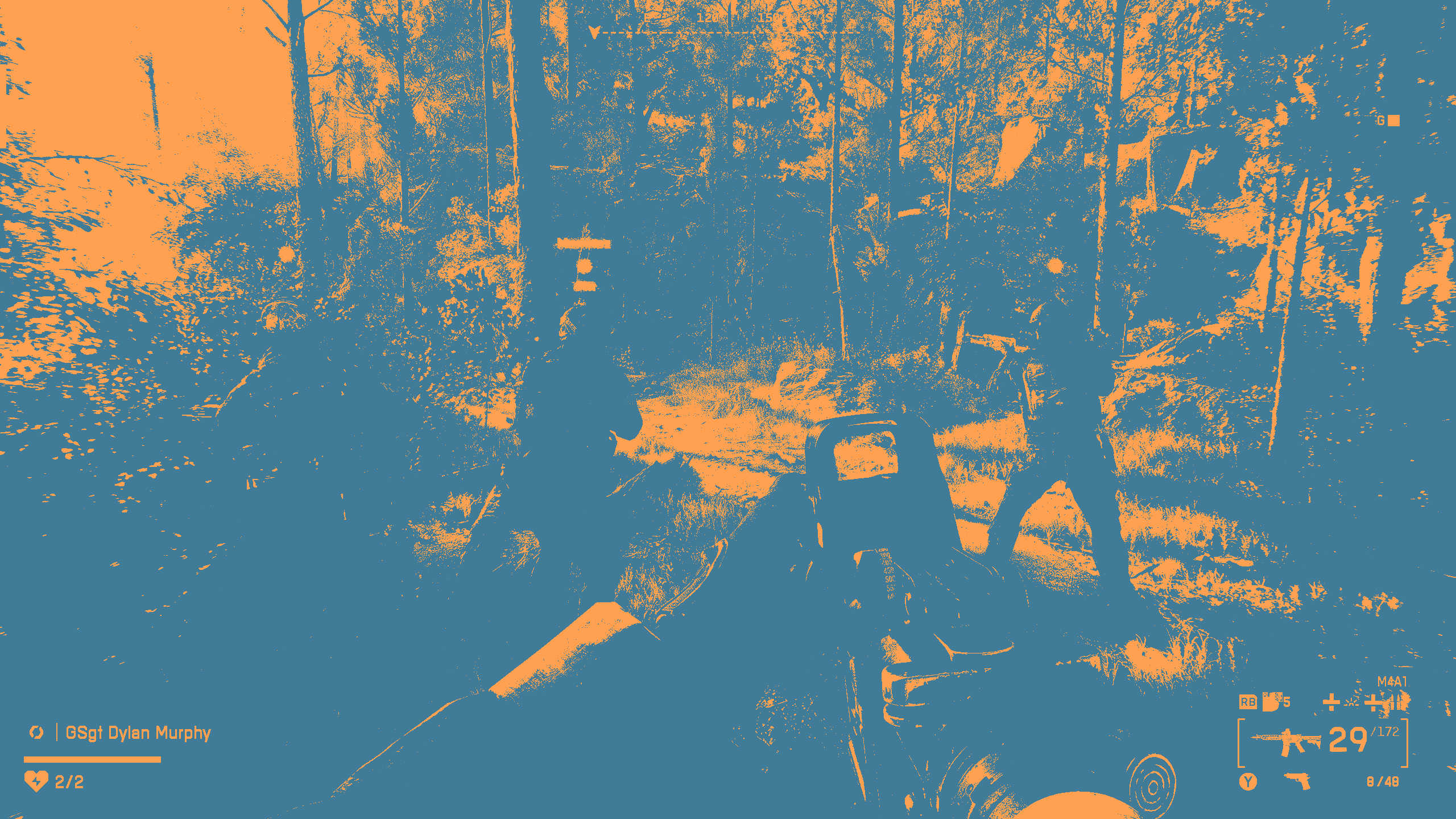
Battlefield 6 is a reflection of war. It mirrors real life conflicts, recorded live and piped daily onto our social media feeds. In a somewhat censored form—limbs don’t detach, skin doesn’t crisp and burn, bullets don’t shatter bone—Battlefield 6 nevertheless evokes these images after a manner. Closer to Platoon than to Nintendo’s Splatoon, Battlefield 6 is modeled, from its brand name weaponry, to its heavy tanks, to its tacticool battle gear, on reality and on real warfare.
To play Battlefield 6 is to play at pretend soldier, and all that entails.
Moises Taveras wrote recently about the distressing ways the game’s images evoke the ongoing genocide in Gaza. Its famous, and aggressively marketed destructible environments, with walls that can be smashed through and buildings that can come tumbling down, cannot be disconnected from the images of Gaza’s humanitarian crisis being shared online every day. Taveras writes that he “ … can’t separate it from the tragedies its environments echo nor can I help but think what a feckless reflection it is of our reality.”
This is undeniably true, but there’s also a tonal dissonance at the heart of precisely how Battlefield 6 evokes Gaza and other modern conflicts that is worth exploring. What’s curious is that beyond the layer of imagery being deployed, it doesn’t feel tragic to play Battlefield 6. It doesn’t rise to the level of existential finality that seeing a family crying over the rubble of their ruined home brings to mind. Battlefield 6’s catastrophes are utterly disconnected, and occur outside of time and place.
After all, the enemy designated by the game’s narrative, Pax Armata, is imaginary and untethered to any one nation or belief system; instead, representing a catch-all for “not us.” They have the same weaponry and tools as their opponents, NATO, the same vehicles, the same camo, just painted with a different insignia, barely discernible when scanned across a raging firefight. When faced off against in the game’s multiplayer mode, they stand on equal footing with NATO. It doesn’t matter who wins, since victory in the next round will likely go to the loser of the current one. It doesn’t matter if a house—absent of any signs of domesticity—used as temporary cover is brought down by a tank shell. It will be resurrected by the time the next round starts. There are no stakes in Battlefield 6; everything is cyclical and abstracted. There are only pieces to be shuffled around a board, no people. The game is entirely drained of the emotional register that an actual conflict might naturally evoke.
In Lewis Carroll's Sylvie and Bruno, a lyrical, century-old children’s book, a character describes visiting a far-off tiny planet. On this planet, two armies are locked in endless combat. After one side loses, “ … the vanquished army ran away at full speed, and in a very few minutes found themselves face-to-face with the victorious army, who were marching home again, and who were so frightened at finding themselves between two armies, that they surrendered at once!” After surrendering they were all shot. But the bullets “ ... were made of soft black stuff, which marked everything it touched.” Such “kills” only counted when soldiers were shot in the back, from the other way around the world. “After that, the worst marksmen were considered the best soldiers; and the very worst of all always got First Prize.”
When the real costs of war are obscured, war comes to resemble nothing so much as an absurd and idiotic game, with made-up and nonsensical rules. Earlier this year, The Guardian obtained a secret interview conducted with IDF snipers, who had shot and killed multiple unarmed members of a single family for the crime of stepping over an invisible, arbitrary line. One soldier remarks in the interview: “It’s a question of distance. There is a line that we define. They don’t know where this line is, but we do.”
Battlefield contains aspects of this random and arbitrary decision making. Beyond the macro rules of capturing more points than the other team, there are micro self-directed tasks that one can occupy themselves with, like camping a point and sniping at enemy soldiers running up from the flank, or piloting a helicopter, or playing medic and reviving everyone you see, or hopping in a tank and raining down endless streams of mounted machine gun fire on an assumed enemy position. There’s an open-ended nature to matches, a light, directionless feeling of engagement; all frantic pleasure, no remorse; shooting ahead and behind oneself, watching the enemy fall, confident that they’ll get back up somewhere else.
It’s a chaotic fun house, choked in the dust of collapsed concrete. A delirious ode to chaos and destruction, the kind of destruction that recalls knocking down a sibling’s sand castle more than the idea of rebar and stone coming down and burying people alive. Battlefield 6 works by getting close to the hot stove of terror and annihilation, without letting players feel the actual burn.
Unlike nations who must rebuild at the conclusion of a war, there is nothing to rebuild at the end of a match in Battlefield 6. All that has been lost will simply revert back into place. As such, there’s nothing much to learn. We cannot form meaning from something so totally detached from the real human tragedy its images evoke. Those IDF snipers, wrapping up their tour of duty, boastful of their asinine and inhuman little games, or an American commentariat who point to undisclosed comorbidities as a sign that a child’s gaunt figure can’t technically be attributed to starvation alone, view the world in a similar way. A game; a distraction; a series of meaningless images.
“They were strange people in that little planet!” Carrol’s character exclaims after hearing the story. On our own strange planet we seem intent on crafting, in games like Battlefield 6, stranger ones still, meant, perhaps, to reflect the incongruence and absurdity of life while still facing away from it, endlessly aiming in the wrong direction.
***
Yussef Cole, one of Bullet Points’ editors, is a writer and motion graphic designer. His writing on games stems from an appreciation of the medium tied with a desire to tear it all down so that something better might be built. Find him on Bluesky as @youmeyou.