0.
What times are these, in which
A conversation about trees is almost a crime
For in doing so we maintain our silence about so much wrongdoing!
Bertolt Brecht, "To Those Who Follow in Our Wake"
(Translated by Scott Horton)
1.
Every time I see a picture of Gaza I remember there are still people dying of cancers linked to 9/11. More than died on the day. Survivors, first responders, clean up crews, Samaritans, residents breathing in carcinogens exposed amidst the rubble. If the heart of an empire had any empathy, it might see the resemblance. But the news doesn't talk about it that way. My family doesn't. The severed white hand found in the Pile is delicately carried to a medical examiners' tent, extensively documented, and traced to a family of the body that was a person. The nameless brown arm hanging limp from the broken concrete that was an apartment is sensitive content, “totally made up,” a statistic. And how do you count the deaths caused not just by carcinogens, but diseases that wouldn’t exist without cutting power to desalination plants? The cancers that can’t be treated in the hospitals that were bombed, besieged, that became sites of executions? They become “indirect deaths,” as if there were no people who gave orders for their deaths, as if a conscripted, indoctrinated teen didn't pull the trigger all the same. From beneath the ruins, the indirect deaths begin to climb.
2.
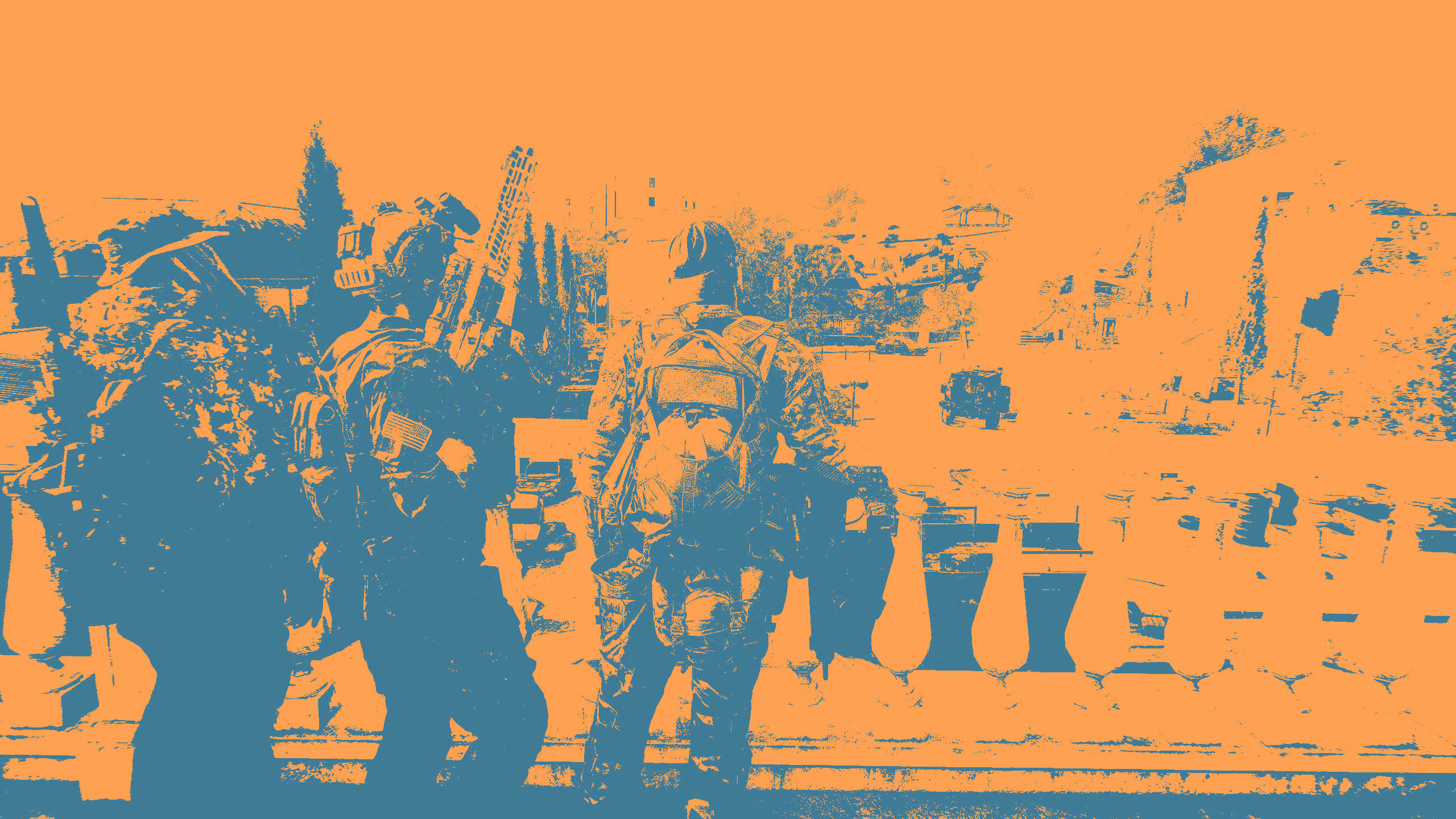
Battlefield appeals to the spectacle of scale: More players, longer matches, bigger maps, and vehicles to traverse them. A weighty je ne sais quoi and destructible environments, the rubble exercises a greater power over the player, one that can supersede agency with awe, briefly decentering bullets as the supreme authority of the virtual world. Battlefield 6 is a game about the rubble, and also about blowback. The baffling campaign that fantasizes about a symmetrical war on terror, the recoil of machine guns and carbines that miss the target, the audio and visuals that mark an operator's fire on the HUD. It’s an information war for a red dot above an avatar that can hardly be seen through the smoke and foliage. I spot an enemy, mark them on my team’s displays, and get points when they’re killed. Someone I stunned with a flash grenade or another player I forgot I damaged minutes ago dies and I am rewarded. In Battlefield 6, KDs reflect all my indirect death. Yet when I am indirectly killed, I only see who pulled the trigger—even if they didn’t know I was hiding in the building their launcher toppled. I wait to respawn, look on, and despair.
3.
“The ruin has no value other than as spectacle,” Leila Taylor writes in Darkly. “A metaphor representing our fear of the abandonment of civilization and our powerlessness over nature.” In the 18th and 19th centuries, Europe’s wealthy built ruined follies in their gardens, a gothic aesthetic popularized by the paintings of Romantics like Friedrich, whose compositions often collaged real world landscapes into something decidedly more picturesque. The artificial ruins built on manicured lawns were no less real than the images that inspired them. Authentic ruins, like Windsor Castle's Temple of Augustus, were appropriated into the image too, making a tautological argument for a Western Civilization. And they still are, indirectly. The Brooklyn Museum tells me the steles of Kalhu belong here, because they would be ruins today if left in Iraq—as if the colonial projects that spirited the genies away didn't destabilize the region for two centuries. Shelley wrote "Ozymandias" in 1818 about the ruins of Ramesseum, and corpses and skulls filled the 19th century ruins of Samarkand and Chuguchak in Vasily Vereshchagin's paintings, but it was “only with the coming of the 20th century, its cataclysmic changes and the genuine ruins its wars spread across Europe and the rest of the world, that the trend for ruin-building faded.” Paul Cooper writes in The Atlantic: “In the ashes of Dresden, Coventry, and Stalingrad, the romantic ideal of the ruin in the European imagination was changed forever.”


4.
Invasions of the mainland, the kind America has not witnessed since British forces armed with muskets occupied Washington in 1814, are the keystone of America's mediascape. The country's predominant ruins today, remnants of deindustrialization, succeed the World Wars. There are no ruins from the war on terror at home, nor any ruins whatsoever at the site of the World Trade Center. All the rubble was removed during the clean up. 60,000 tons of steel were sold overseas. Other metal was used in the creation of public memorials in each state—what had crushed and poisoned, become sacrosanct. Now, just a mote of the 1.8 million tons of rubble remains at the site in a museum with ticketed entry and a gift shop, a monument to that colossal wreck. Lest the ruins remember what conflict looks like, the official history will never forget the pretext for the indirect deaths of over 4 million people. What, then, are the virtual ruins of Dumbo in each breakthrough match on Manhattan Bridge?
Battlefield 6 is a folly: Trailers and keynotes detail all the ways players can wield power over the sublime force of its ruins—awesome in its most trivial and lofty senses. And like Hagley Castle, built in 1912 with incomplete, sloping towers, the ruins of Battlefield 6 are evocative of the faux ruins of other representative mediums. The color grading and lighting mimic the distortions of lens and film. Its most immersive audio settings, War Tapes, promises to echo not combat, but mastered recordings of it. Its ruins are also playgrounds for a Western world affluent enough to afford the graphics cards made of minerals mined in Africa and manufactured in Asia. And Battlefield 6 is folly: Ars Technica reports the game cost over $400 million to develop, with EA setting the impossible metric of success at 100 million players. (It has sold 10 million copies.) What emotions it stirs, what nostalgia it coopts, now rendered profit for the Saudi government.
5.
Israeli forces have now dropped more explosives in Gaza than fell on London, Dresden, and Hamburg combined during the Second World War. More than fifty thousand Palestinians have been killed. Hospitals have not been spared; most are no longer functional. A few weeks before my trip, the World Health Organization reported that more than a thousand health-care workers had been killed, and that it had verified six hundred and fifty-four strikes on Gaza’s medical facilities. The territory’s health sector was “being systematically dismantled,” a W.H.O. representative said. Just last month, Israeli soldiers were filmed opening fire on ambulances in southern Gaza, killing fifteen rescue workers. An I.D.F. spokesperson initially claimed that the vehicles were “advancing suspiciously toward IDF troops without headlights or emergency signals,” but the I.D.F. walked back that statement and opened an inquiry after footage published by the Times showed a uniformed medic next to motionless and clearly marked ambulances, followed by five minutes of gunfire from the I.D.F.
—Clayton Dalton, "Hospitals in Ruins,” The New Yorker (April 18, 2025)
6.
What remains when the rubble is cleared? Who will live to see the final score? Two months of season passes and kill streaks, of reviews and scoreboards; Two years of death and disease, of consent manufacturing and record keeping. Every time I play Battlefield 6, I see a picture of Gaza.
𝄌.
…so why do I tell you
anything? Because you still listen, because in times like these
to have you listen at all, it's necessary
to talk about trees.
Adrienne Rich, "What Kind of Times Are These"
***
Autumn Wright is a critic. Find them online.