This article discusses plot details from throughout The Roottrees are Dead and Roottreemania.
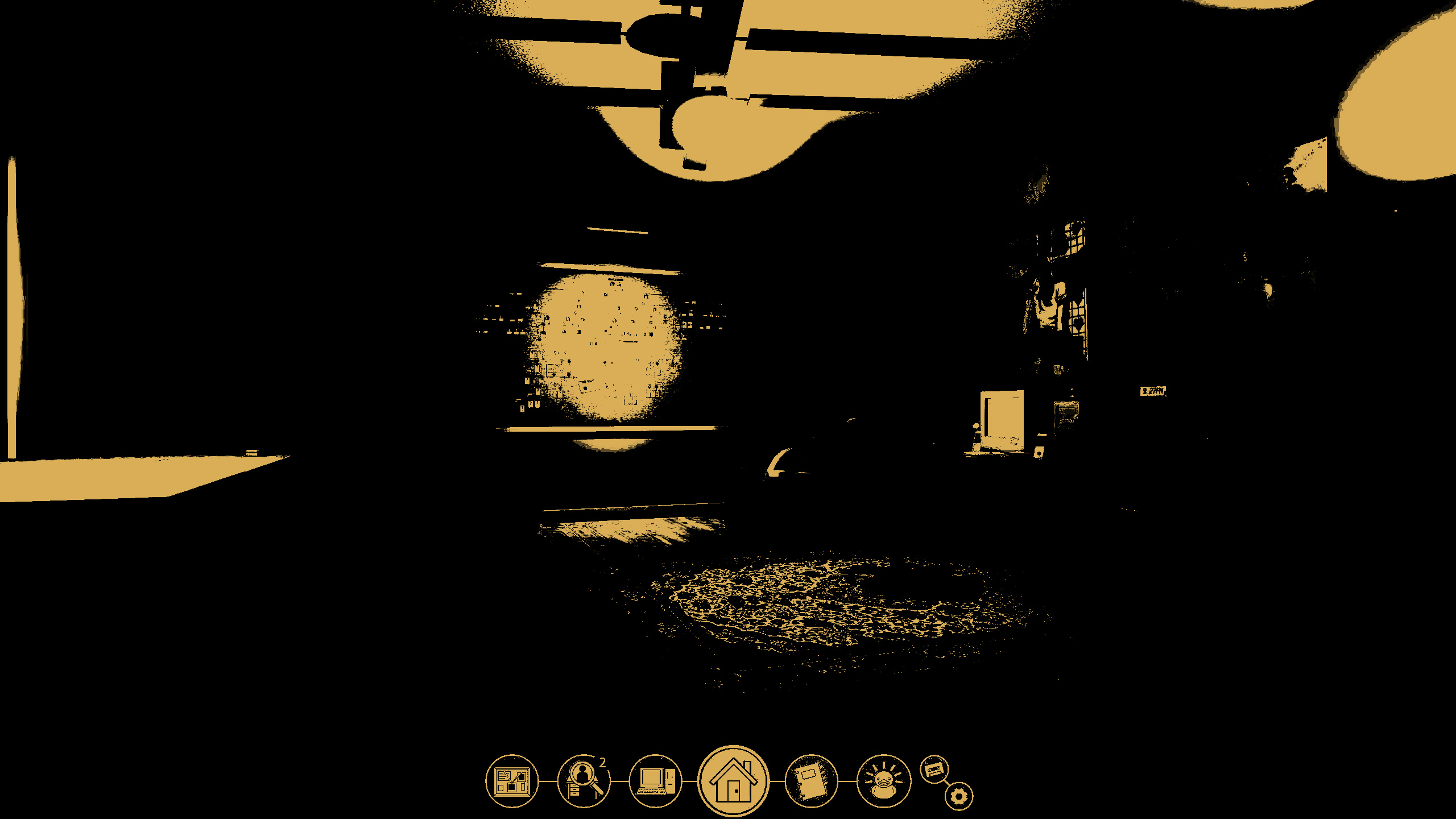
The Roottrees are Dead is a detective game. You play as an unnamed investigator, low rent enough to work out of what looks like a bachelor apartment, with a pulp detective poster hanging above your desk for inspiration and nothing but a desktop computer and a corkboard as tools for your work.
A mysterious woman appears one dark and stormy night and explains that a father and his trio of daughters, the CEO and three heirs to the Roottree candy dynasty, have died in a plane accident. The company’s vast wealth must now be distributed through an inheritance policy that only pays out to direct descendants of the original founders. The woman needs someone to piece together the Roottree family genealogy in order to sort this all out.
She leaves a few clues behind, in the form of photographs, old advertisements, and a list of important names, and you’re set loose to figure out the rest. Over the investigation that follows, secrets shake loose from the family tree like rotten fruit. There are hidden relatives and affairs, spats and betrayals by siblings. Eventually, once the genealogy is complete, the mysterious client reveals herself to be the now-adult daughter of one of the early Roottrees. She was born out of wedlock, it turns out, and raised by a farmer and his partner, a secret Roottree who, as a gay man in early 20th-Century America, was removed from official family records. The woman writes a book about these scandals.
In the game’s expansion, Rootreemania, the genealogy sprawls even further thanks to a follow-up investigation that reveals more of the family’s dirty laundry. Following the book’s publication, a surge of new inheritance claimants has arrived, which requires you to sift through further information to see who among them might be a valid Roottree. This involves digging even deeper into the Roottree’s previously hidden affairs and assessing the backgrounds of illegitimate children. In the process, our perception of the family changes yet again.
Aside from offering a well-constructed mystery to unravel, The Roottrees are Dead is compelling for the way it shows how shallow any objective understanding of something as complex as even a single family can be. By the time the family tree is as complete as it needs to be for the game’s purposes, you have a vast overview of roughly a century of Roottree history. A list of names and occupations, of spouses and children, is not much of a summary for how much has gone on between the lines, though. The family's true nature is formed in between the details of the official record. We get a better understanding of various Roottrees not through the dry facts of their marriages and occupations, but by the ways in which they treated others, spent their money, or reacted to learning about family secrets kept hidden to avoid scandal.
Pointing out that there’s more to a family than its genealogy is a simple enough concept, but it gains extra dimensions in Roottrees through the game’s setting and method of play. Set in the late ‘90s, around the beginning of the digital age, the detective’s primary investigatory tool is their computer. This includes a virtual notepad and dial-up access to online magazine, newspaper, and book libraries. Most importantly, it means trawling through the results pulled up from a fictionalized version of ‘90s search engine WebCrawler, here called SpiderSearch.
The game’s primitive internet hints at technological advancements to come in the next few decades, from online ancestry mapping services and social media to the predictive algorithms now called AI. The advent of home internet offered anyone with a computer and a modem access to seemingly unlimited information. This has only become easier, and the volume of raw data greater, over years of iteration and increased sophistication. Today it seems possible that you might understand a person, at least on some level, just by pulling up their social media profiles, reading their opinions and discovering whatever facts about their life the internet has catalogued.
A person is more than their data, though, even as that data accrues on the internet to form a convincing digital double of a real self. The more we give the internet our personal trivia—or have it taken from us—the more it seems like what you can gleam about us online is a full representation of a human being. It’s tempting to think you can really know a person based on their internet presence, but there’s always a lot left out, a lot that exists outside of the facts.
In an era of tech where complex algorithms are likened to gods and, when deployed as chat bots, are capable of fostering powerful delusions in users, it’s worth remembering how much of life occurs in the spaces between facts. The Roottrees are Dead shows that to really understand a life, you need more than just data points.
***
Reid McCarter is a writer and a co-editor of Bullet Points Monthly. His work has appeared at The AV Club, GQ, Kill Screen, Playboy, The Washington Post, Paste, and VICE. He is also co-editor of SHOOTER and Okay, Hero, co-hosts the Bullet Points podcast, and posts on Bluesky.