Poetic is not a term I often use to describe games. Perhaps because, even after spending years toiling away on a PhD in poetics and teaching undergraduate students in the subject, I find it evades precise description. Does 'poetic' refer to an author’s propensity to use allusions, metaphors, and allegories? Or perhaps verse-like language structures, where meaning is implied, not stated? Or is it just a stand in for emotional impact, deployed when a synonym is needed? Whichever it might be, it seems like other critics are as reticent to use it as I am. I can’t think of a recent game that was widely considered or described as poetic. In fact it feels like there might be something fundamental to games that excludes them from the poetic completely, as if their need for systems, maths, and strategy rob them of the ability to evoke poetry.
And yet, given all this, Many Nights a Whisper is a game I would call poetic. It’s a game where, sitting down to try to capture what its one hour experience evoked, poetry was the first thing that came to my mind. I suppose it begins with the title, an allusive epithet that stands out amongst a form where names so often are statements of direct action. Popular suffixes for game titles are often terms like -fall, -war, -craft. Percussive and direct, they have their own poetry, but is it really poetic? Meanwhile, “Many Nights a Whisper” is a weather-worn fragment, a chunk of terracotta found without subject or object, inviting your curiosity and input. It’s a gorgeous title, a lyric not a pronouncement.
But we are talking language here—of course it can be poetic. A game title can be poetry, and “Many Nights a Whisper” certainly is. But Many Nights a Whisper also contains poetry in its most irrefutable form:
“Oh, Dreamer behind the wall
Hear my heart’s faint call
Dreamer take my braid
Or watch the dream turn gray”
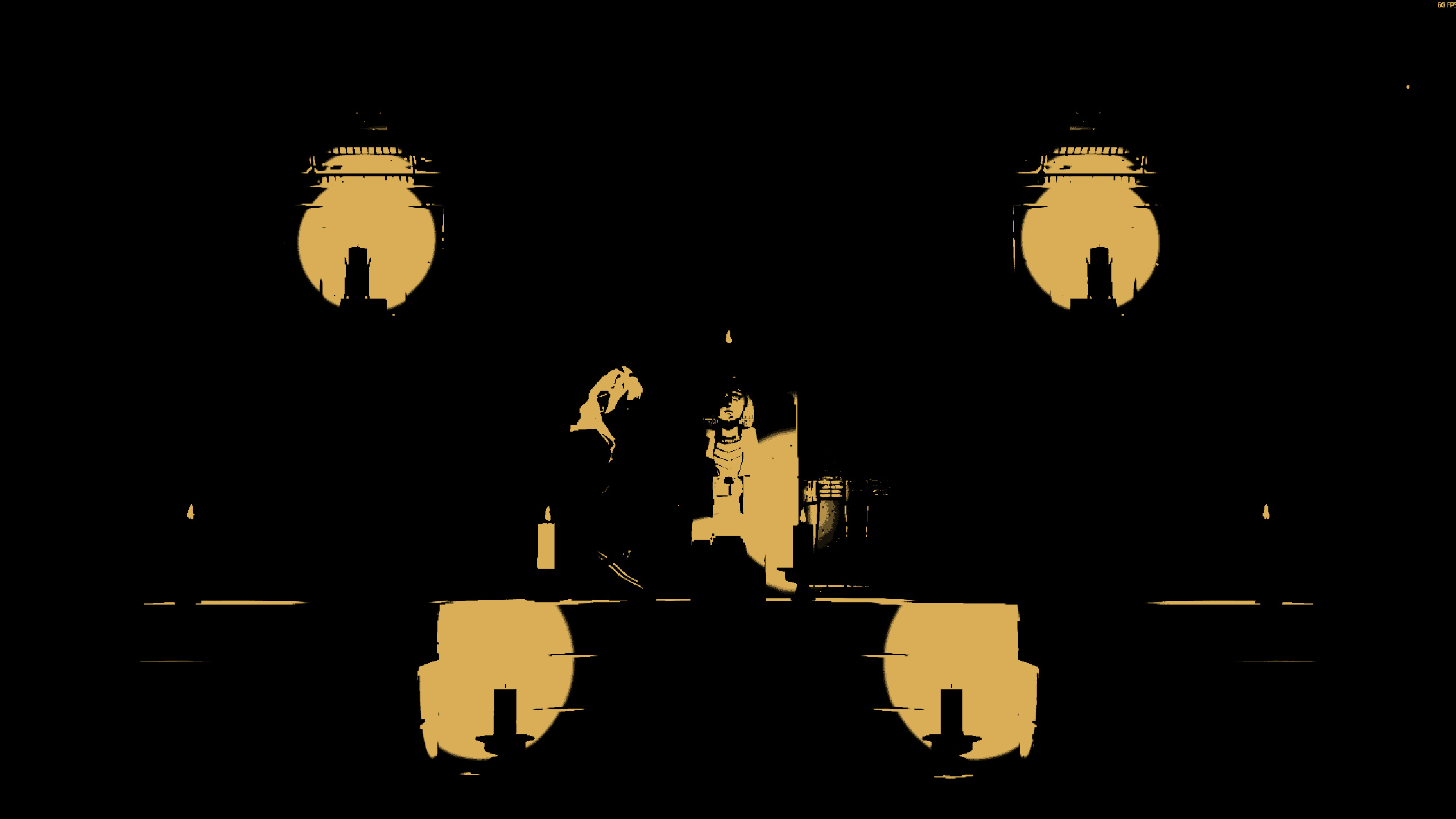
A stanza of verse, a prayer, spoken to you (the dreamer) each night as you decide whether to grant a person's wish or not. This is the subject of Many Nights a Whisper; the preparations for a ritual where you must fire a flaming ball from a sling into a vast torch, lighting it and granting the wishes of those whose braided hair was donated to your cause. It's a simple structure: each day you train as much or as little as you like, testing your sling and your accuracy on a variety of different targets. Each night you accept or refuse the unseen people’s whispered wishes, taking their braided hair if you do, strengthening the power of your sling. If, on the fated night, you manage to hit the distant target, all the wishes you accepted will be granted, as a new age begins.
This is what makes Many Nights a Whisper poetic: not verse or allusions, not even language, (much of its text is resolutely prosaic) but the ritual it creates, stages, and complicates over the course of the game. Forget rhyming couplets, this is a design that rhymes, that repeats. Each day a stanza that complicates the whole. Wishes are added to the tally, wishes you carry the weight of as you practice your drills. Petulant, grand, selfish, expansive, impossible, bizarre, human wishes. They run the gamut from wishing for eternal life, to wishing for a patch of extinct flowers to return. From the total abolition of gender, to the granting of a pink cat invisible to all but its owner. Those wishes become increasingly difficult to grant with ease, bringing into question free will, utopian thinking, and personal gain over societal change. The game circles back, goes again, finds pattern and lyricism in repeated action, in layering meanings, outcomes onto that action. Being a container for poetry does not make a game poetic, but a thesis expressed in design, in player experience and interaction, does.
The last time I felt the same kind of poetic quality was with Playdead’s highly lauded Inside. The game has occupied my mind since it was released in 2016, and I must have replayed it tens of times. Each time, I kept having this sense that the game was a “prose poem”, a form that I love deeply. Something in the running-on of its locations in sequence evokes not a story, but a thesis, an inquiry. It's not a series of plot events, and instead a self-reflective open form. The repeated puzzles and set pieces that all explore ideas of authority and control seem intended to rhyme, to color each other. It is a game without language, not a single word spoken, but to me it has always felt like a balance of the prosaic—logical, narrative, sequenced—and the poetic—affective, connective, circular. A prose poem. So there was nothing more satisfying than, in my many playthroughs, to uncover, hidden in a symbol language within the game, the title of an E.E. Cummings poem: "Pity this busy monster manunkind." It felt like the rosetta stone to critically understanding Inside as a poetic form, to understanding what a poetic game might be.
Many Nights a Whisper and Inside share this poetic quality. Both are interested in staging poetic situations that the player must then navigate and experience. Actions carry meaning beyond plot or narrative, and instead feel symbolic, exploratory. Both have a compressed, circular feeling, a spiral of meaning that depends on every twist and return. But they differ too. Many Nights a Whisper finds poetry in ritual. The entire game is staged around two rituals: the lighting of the torch, and more importantly, the whispering of the wishes. This engagement with ritual is perhaps the key to understanding how it is poetic as a game. Its developers understand ritual is not about superstition, but about a poetic vision of reality. Ancient peoples did not believe the moon was a rabbit, or the sun pulled by horses in a literal sense. They understood it in a poetic sense. That is to say, how is the moon a rabbit? What might casting the moon as a rabbit elucidate about its qualities, its meanings? What might calling the sun a chariot say about power, violence, and strength? How does it reflect the role the sun plays in our life? In the same way, the rituals of Many Nights a Whisper are not concerned with the literal magic of granting wishes, but instead the poetic power that whispered wishes might carry. How might a wish change the world by being spoken?
In this way, Many Nights a Whisper has helped me to understand how a game might be poetic. It demonstrates a refusal of literalism, and an engagement with ritual, performance, and the staging of a thesis. This has always been the power of poetry: to take a quotidian material, language, one we use and experience unthinkingly everyday, and to transform it. To draw strange comparisons and allusions between objects (“how is a raven like a writing desk?”) in order to transform or at least to allude to a transformation; to express the inexpressible through tricks of syntax and meaning. Many Nights a Whisper ends, whether your shot is successful or not, before the granting of the wishes. That is because it is a game about wishing, not about getting. It is a game about how language might change the world. About desires both fulfilled and unfulfilled, and how they shape us in action and speech. And it is interested in how staging such thoughts through ritual complicates them, brings them to life, and provides a poetic space for the player to reflect within. How, it asks, can we perform a shift, can we change the world, with language? Be it thought, spoken, sung, or perhaps, in the dark of night, whispered.
***
Gareth Damian Martin is a writer, designer and artist. They make games as the one-person studio Jump Over the Age, and are the creator of Citizen Sleeper, Citizen Sleeper 2: Starward Vector and In Other Waters.