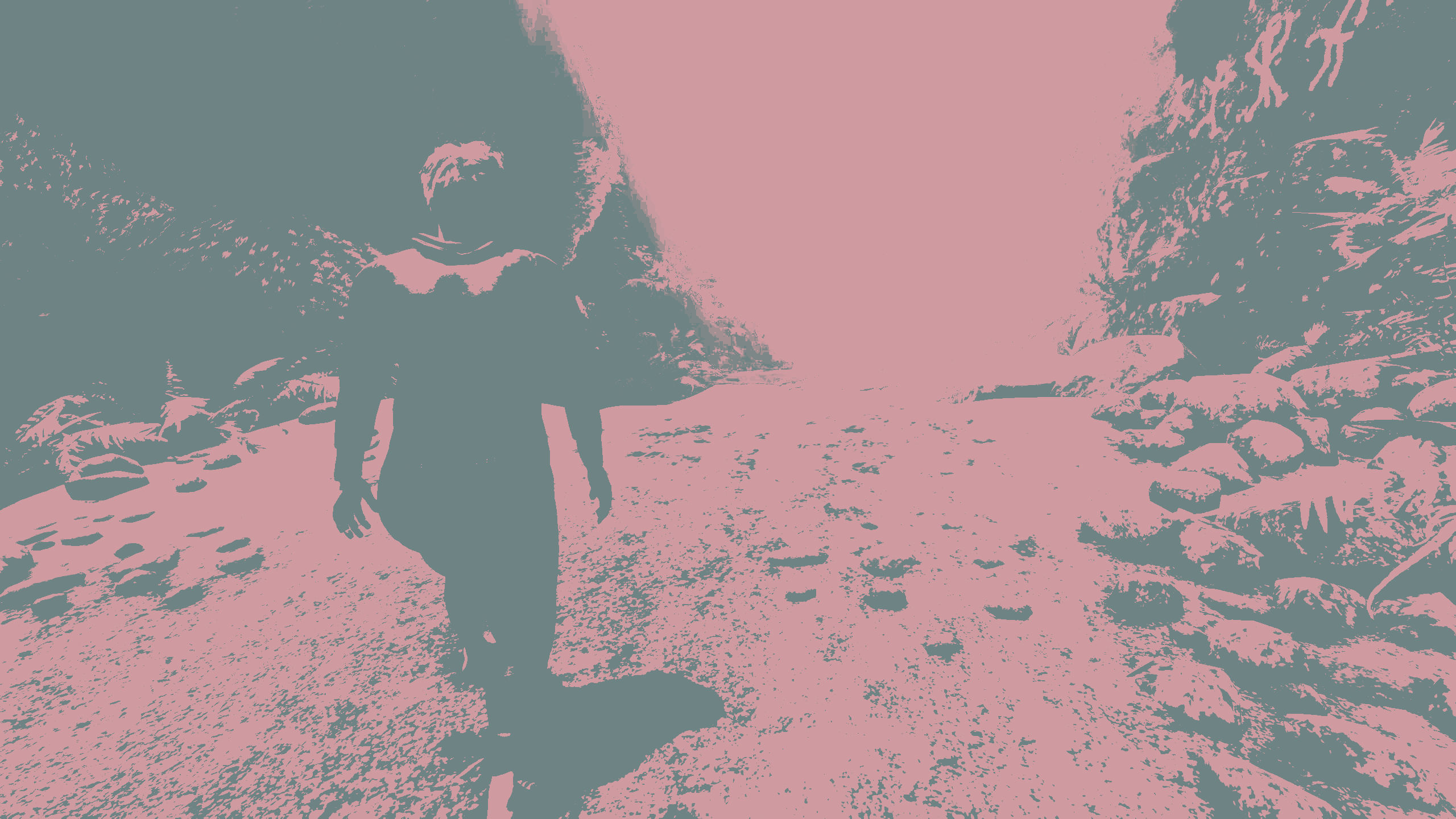
There are two articles I wanted to write about Baby Steps, one short, one long. They’re both in here. The short one comes first.
Fully Dynamic Onesie Soilage System
I played Deus Ex: Human Revolution and Deus Ex: Mankind Divided around the same time as I was playing Baby Steps, and I tell you, robotically enhanced super soldier Adam Jensen couldn’t possibly navigate the strangled, fractured, and all-round anti-traversable world that is surmounted by chubby adult toddler Nate. I kept thinking about Skyrim as well, where you play the mythical, dragon-blood-infused Dovahkiin/chosen one, but the only way you can get over slopes of moderate or above gradient is by horseback. Regardless of their preternatural abilities as written, it only takes a waist-high obstacle or a path narrower than the breadth of their shoulders to render most videogame heroes useless. I think of Master Chief, stuck running on the spot because the hill he’s trying to climb is too steep for his movement animations to accommodate, or Lara Croft, unable to mantle a ledge because it has a slightly irregularly angled lip, not one that’s 90 degrees.
These are contrivances of direction and path-finding, ways of corralling the player along a game’s golden route. There are times when this type of artifice might be too much for our suspension of disbelief—why can’t you go up this staircase in Silent Hill 2 Remake? But usually, visible-invisible walls like these are tolerable oddities of videogame language. We accept them as the mechanisms that make the more crucial parts of games work, until we discover and formalise more graceful mechanisms.

Nevertheless, they lead to a strange paradox in Baby Steps, a game which is at least partly premised on its protagonist’s slapstick inability to walk like a normal videogame character notionally walks. We’re meant to see Nate as something of a clown, and the experience of playing Baby Steps is designed to make us more consciously aware of the actions and inputs that we typically take for granted in videogames. But the controls, animations and multifaceted movement mechanics of Baby Steps mean that Nate is considerably more able to traverse difficult terrain than the archetypal game heroes to which he is subtextually being compared. Nate is also relatively free to go where he likes—although some paths are easier to walk than others, Baby Steps encourages you to find your own, often esoteric, means of reaching the next geographical waypoint, so compared to a lot of other games, where your sense of a place is defined by where you can’t go, in Baby Steps, you’re rarely curtailed by artificial borders. This is not to make judgements either on Baby Steps or the nucleic conventions of videogames that it invites you to notice, except to say that games are perhaps so detectably artificial and contrived already that their contrivance is difficult to parody or satirise, and that it’s equally hard for a game-maker to ‘make a point’ by exploiting or exaggerating those artificialities. Although they’re extremely absurd, Baby Steps’ movement and navigation mechanics are arguably less absurd than the movement and navigation mechanics that we accept in games as normal.
Donkeys v. Crickets
Yussef characterises Baby Steps’ vision of a certain kind of maleness: “unmothered men making due through expressions of nonsensical masculinity.” If the canonical ending, Nate and Moose together in their cabin, feels like any kind of resolution, it’s because it creates the impression that the pair have successfully escaped from, or risen above (they are literally on top of a mountain) the cruder, more emotionally stunted world of macho heterosexual men that they’ve encountered throughout their journey. The dramatic climax of Baby Steps is when Nate asks Moose if he can come into the cabin, his small expression of vulnerability, need and willingness to seek help representative of a kind of graduation from the insecure and solipsistic ‘masculinity’ symbolised by the majority of the game’s characters. If the game’s understanding of men up until this point feels superficial, even misanthropic (you’re either one of the donkeys, a rude, overbearing braggart preoccupied with his basest sensual urges, represented in Baby Steps by drinking and smoking, or you’re Nate, the meek, directionless, physically unripe loser) this ending suggests that these two unrefined ‘types’ of maleness, rather than being in opposition, together form a kind of crucible, in which a third, more complete man might be forged. Given the rough terrain, harsh climates and withering setbacks that he faces, Nate has to ‘man up’. But all that priapism is for naught unless he can also, in the end, find qualities like communication, emotional availability, and sympathy and empathy.
But this optimistic vision of how maleness can be shaped is contradicted by a number of other sequences. As Nate nears the top of the mountain and Moose’s cabin, he meets a gigantic woman who picks him up, cradles him, and sings to him like he’s a baby, and then places him down atop an otherwise insurmountable ice shelf, helping him on his way. During a short hallucination sequence, Nate also imagines the sound of his mother’s voice, gently encouraging and guiding him through a labyrinthine abstraction of his family’s house. Although these characters only appear fleetingly, they are both maternal, supportive, reassuring, and loving mother figures. The giant woman is a caricature of motherhood. Nate’s mother is literally his mother. If the game invites you to discover or appreciate a more complex vision of maleness, femininity by contrast is rendered in an elemental form. The game seems to appreciate the possibility of a nuanced man. It doesn’t seem to have the same kind of appreciation for the possibility of a nuanced woman.
The women in Baby Steps inhabit the strictest roles of their gender—they are mothers and suppliers of gentleness. The giant can also be reverse engineered to quasi Freudian, psychosexual domination fantasies, the mother who can physically destroy her manchild, the mommy domme. In that reading, Baby Steps becomes even more of a game from a male point of view, one where women, if not to be mothers in the domestic sense, exist for sexualisation. The suddenness of the giant woman’s appearance—the jump cut to her holding Nate like a baby—also makes her scene feel as if it’s being played for comedy. Baby Steps is a comedy game and the sequence with the giant uses the same visual language and tone as the other joke scenes. As well as introducing an icon of stereotypified, sexualised womanhood, the scene invites us to laugh at, or at least find bemusing, Nate’s fragility and softness here. It begins to feel as if the game’s ‘voice’ is more that of the donkeys, who have relatively flat ideas about what it means to be a man, and by implication, a woman, too.
If you choose to use the stairs rather than climbing the gigantic Manbreaker mountain, Jim will meet Nate at the top and mock him for not having the courage to take on and surmount the rock face. On the surface, the scene serves to further define Jim as the embodiment of that certain kind of insecure, bumptious masculinity—implying the ludicrousness and superficiality of a masculine want for status, he insists that Nate has to call him ‘lord’ from now on. He also makes Nate wear a sticker which identifies him as a member of ‘Jiminy’s Crickets,’ that is, a derogatory, informal ‘club’ comprised entirely of men who were unable to climb the Manbreaker and had to take the stairs; men who Jim’s derided for their deficiency of testicular forbearance; weak men. Momentarily, it seems as if we’re supposed to feel sorry for Nate, and in turn, a certain suspiciousness and resentment towards Jim and what he represents. But then we get an achievement: “Jiminy’s Cricket - Joined the hallowed ranks of Jiminy’s Crickets.” The Steam icon for this achievement is Jim’s hand pushing the sticker down on the head of a miniaturised, literally baby-sized version of Nate. Combined with the sarcasm dripping from “hallowed ranks” it's as if the game itself is now taking its turn making fun of Nate and his weakness
The physical environment of Baby Steps is unremittingly hostile towards Nate. Long periods of his progress can be wiped out by single, tiny, innocent mistakes. Even the flattest fields and gentlest slopes are booby trapped with ridges to trip him up and make him fall flat on his face. It creates the impression of a world that is intolerant of imperfection. Baby Steps often feels like reality as perceived by the donkeys, or more specifically, like a reflection of a worldview consistent with dogmatic and aggressive types of masculinity, where everything is a competition, the superior eat the inferior, and the only way to win is to never accept anything from yourself that is less than flawless—and where winning is all that matters. In combination with the plinky-plonky music score, composed largely from comedy sound effects arranged in madcap disorder, the game often seems to participate in humiliating Nate.
But there is a final doubling back, as it were. The implied ending of Baby Steps with Moose and Nate together suggests that the game is ultimately ‘on his side,’ and perhaps on the side of the maleness that he represents rather than the donkeys. However, if you return to your save game and take Nate on a final walk to the mountain’s very summit, there is a hidden, actual ending which arguably illustrates that point with greater clarity. Nate opens the crotch of his onesie and, in a final act of transfiguration, starts to urinate outdoors; throughout the game, his unwillingness and inability to do this has been a metaphor for his insecurity and lack of manliness relative to the other characters. Suddenly, Mike, another hiker, one who was able to climb the Manbreaker, seemingly with ease, appears behind Nate and makes him jump: “Having a wee, Nate?” he barks. For a second, Nate freezes. His stream sputters. He’s nervous. Mike, however, is merely a figment of his imagination—when Nate looks around, he’s disappeared. Relaxing, he starts to urinate again, and this is the game’s final image: Nate, having apparently dispelled the spectre of a more bullying, judgemental type of maleness, at last at peace. His ‘softer’ virtues remain intact—his home is with Moose, and among all that that represents. But he is also, at last, reconciled with his gender, symbolised, in this moment, by his indulging one of the multitudinous privileges that come with having a penis. If Baby Steps is often party to bullying and degrading Nate, in the finale at least, in its own especially crude way, it seems proud of him, having dragged himself free from his impotent basement life without losing himself to, or assimilating, the donkey state of mind.
***
Ed Smith is one of the co-founders of Bullet Points Monthly. His Bluesky handle is @edwardsmithwriter.