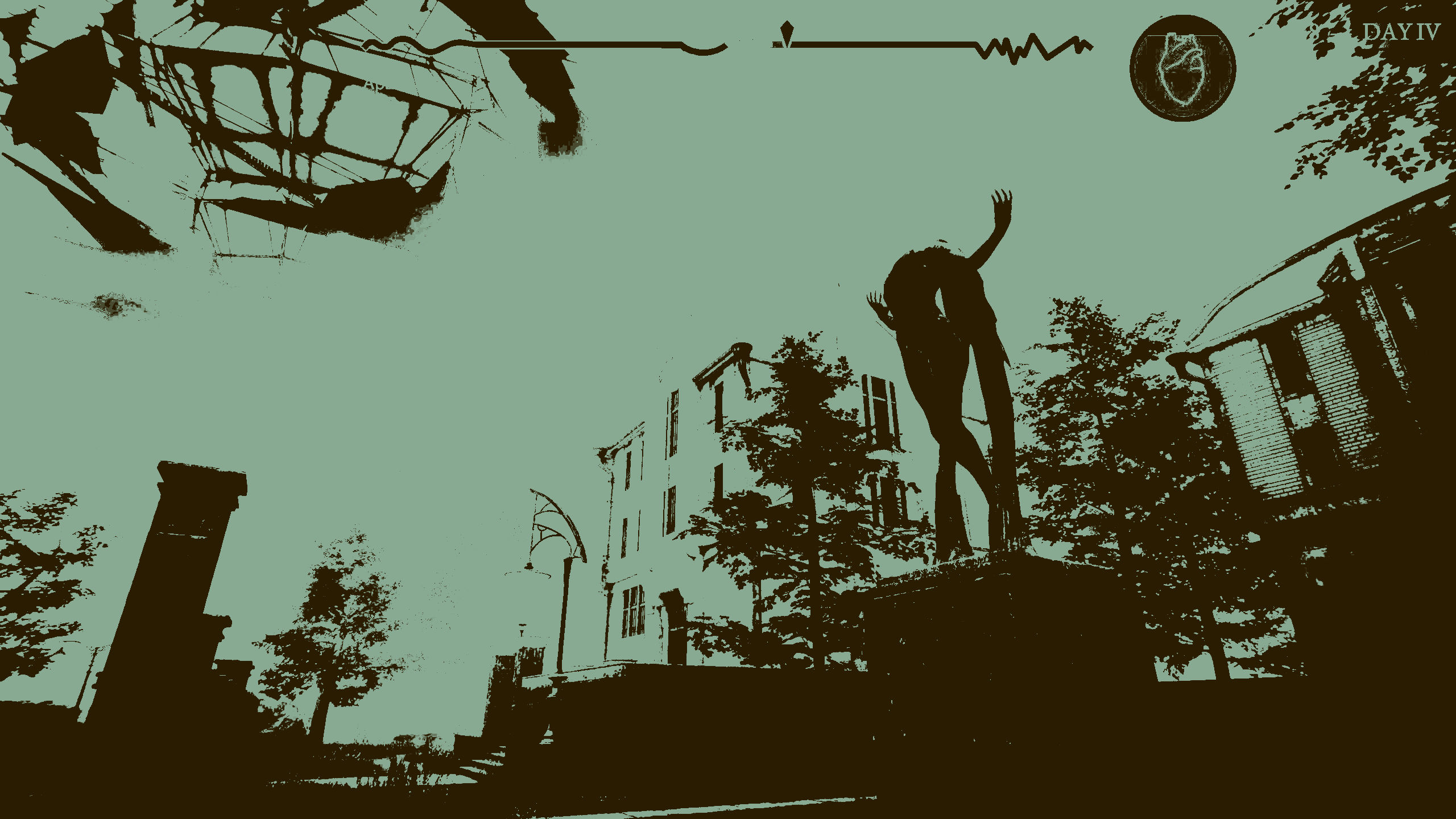
Pathologic 3 introduces its world by placing you in a series of traps. In quick succession, you visit a locked room, a hostile interrogator looming over you; a prison cell, punishment for crimes your player character did before you got here; and the Town itself, a small Steppe village that will soon be quarantined in an effort to fight a vicious, possibly sentient plague. Again, this last one was also your fault—quarantine orders came from one Doctor Daniil Dankovsky, Bachelor of Medicine. You.
Pathologic 3 wants you to feel confined.
///
With two followup games and twenty years of hindsight, it now seems somewhat odd that Daniil Dankovsky, a prissy, stuck-up doctor from the far-off big city of the Capital, is the character who introduced players to the world of Pathologic. He's a dreamer, with big, utopian ideals—he believes death is a pathology that can be cured—but he is, fundamentally, a rationalist, an inheritor of Enlightenment thinking. He believes mankind can reason its way out of all its problems, and he's here to help.
But the Town, as it's presented in the series, is anything but rational. Utopians exist here—plenty of them—but even they are mystics, trafficking in the creation and nurturing of things which defy "natural law," as Dankovsky might put it. And just one layer deeper in the Town's culture, pure magic begins to seep out. Impossible creatures. Earth that bleeds. Plagues that talk. In that sense, the other two protagonists of the series seem more appropriate—a magic child born yesterday (literally) and a local with medical training outside the Town, placing him as both insider and outsider, the perfect liminal guide.
Yet, if you pick up the newest game, clearly built to be approachable to new players, or try out the first one, you'll find yourself saddled first with the Bachelor, a man who only believes what he sees and often fails to see what he really needs to. Odd, no?
That child, the Changeling, even comments on this, early on in Pathologic 3. She wonders why the Bachelor, of all people, is actually able to see the shabnak adyr, a creature of local myth and walking personification of the plague. Surely he's not the type.
"Why you, with your head of solid oakwood, can see her is a very interesting question," the Changeling says, in one of the sprawling game's few truly mandatory dialogues. "Most people like you are completely blind ... What ripped that hole in you, I wonder?"
One of the available responses is, simply, "I don't remember."
///
Dankovsky's been forgetting a lot lately. Early on, the game introduces its central gimmick, a time-travelling ability that lets Dankovsky travel to any of the game's twelve days out of sequence (with some limitations, including a resource cost that can become, in true Pathologic fashion, incredibly punishing if taken for granted). This gimmick lends play a thick air of disorientation. It's easy to forget when in time you are, and due to Pathologic 3's other major change—breaking the Town from one playable map into several smaller ones—it's easier than ever to forget where.
But for Dankovsky, the biggest question isn't when or where but why. Why am I trapped here, in this prison cell? In this town? In this interrogation chamber? You and Dankovsky both experience so much out of order, learning about your own actions in advance, only to be later given the opportunity to enact or rewrite them directly. Causality itself can come to feel unstable, despite the game's laudable attempts to help you track events via an in-game mind map. Nothing unravels the way it's supposed to. No one does what you expect.
In turn, this confusion reinforces the early game's sense of confinement. You are playing the role of a man trapped by choices he does not remember making in places he does not understand. In this way, Dankovsky is often less doctor than he is escape artist, working to understand and therefore massage the progression of events around him just enough to get out of whatever jam he currently finds himself in. You play in loops of information gathering and reactive action, leaping around in time to find breaking points in causality and then use them, Scott Bakula always trying to find the one path home.
It gets to a point where, after a while, you might start to wonder whether Pathologic 3 is about a plague at all.
///
My jaw dropped when I found the pantomimes in Pathologic 3 for the first time. In both prior games, the Town's theater showcases a surreal, self-referential pantomime performance at the end of every day. These pantomimes reflect back the day's contents to the player, offering commentary, letting you know that the world of the Town is not quite coherent in its sense of "reality."
In Pathologic 3, you are returned to your home base, Eva Yan's home, the Stillwater, when the day ends. You cannot go to the theater. But if you go outside you find that the theater has come to you. The skybox and out-of-bounds areas of the map have been stripped away like a set to reveal a massive rendition of the theater's stage. Your entire version of the Town exists inside it. A model. A diorama.
It's beautiful, a level of spectacle I did not expect from a game mostly about walking and talking.
In all of Pathologic 3's pantomimes, Dankovsky is absent. The other characters speak of him as if he's already dead.
///
The question of focus is never one Pathologic 2 invites a player to ask. The plague, as a destructive, possessive, all-consuming problem, is that game's core focus. It informs all the mechanics. As the local-turned-surgeon, Artemy Burakh, you have to keep yourself fed, watered, and swathed in enough PPE to survive journeys into plague districts. All your actions are focused on surviving, saving lives, and finding a cure. The plague talks with you constantly, taunting you, whispering dirges in your ear if you get infected.
Of course, Pathologic 2 is about more than the plague. It cares deeply about colonialism, grief, the specter of death itself. But it never loses sight of that core preoccupation, that one inciting problem. Something is making you and your loved ones sick, and you have to stop it or everyone is going to die. Not free of nuance, but simple.
Pathologic 3 is not nearly so single-minded. You deal with the plague every day, sure, treating patients and investigating leads. But the loci the game returns to are different, now. Confrontations with illness begin to feel like, well, your day job. Seeing patients is wrapped up in a nice minigame package, a straightforward investigation puzzle that you only have to do once for each calendar day. Your duties as lead of the epidemic response are, likewise, limited, just a decree board with a few meters to track and cards to place, only occupying you for a couple minutes at a time. These are things Dankovsky must do, but they're not why he's here.
The plague is almost beside the point. It doesn't present an enemy for Dankovsky, not exactly. It's more like a clock.
///
Eventually, like any prey animal bent on survival, Dankovsky gets pretty good at wriggling his way out of traps. As he does, you, as both player and Dankovsky, begin to realize just how interlocked these traps are, how overlapping. Like an escape artist trapped in a straight jacket, that itself is sealed with a padlock, who also happens to be trapped underwater in a confinement tank, Dankovsky leaps out of one problem to land directly in the next, one prison inside another, inside another, inside another. A path spiraling outward.
And at some point, maybe one or both of you starts to realize you know the answer to the Changeling's question after all. Maybe it's on day—eight? nine? I can hardly tell anymore—when Eva Yan dies, jumping off the Cathedral in order to pledge it her soul, just as she did in the original Pathologic. A tragic act of pure agency that, now, finally, after so many years, you have the opportunity to stop.
Or maybe it's when the game cuts back to the Capital for another surreal interrogation, instead this time you're let out to see to a medical emergency, and you find a plague victim here where there should not be one, and as you talk to him you realize that it's the Bachelor himself, another one, here, somehow, a Bachelor who ran and carried this illness back with him because of course he did because that's exactly who Dankovsky has always been, isn't it, who you have always been. Why did you think that you could be the hero of this story? You can't even save yourself.
You did it. You tore this hole in him. When you refused to let him die, at the start of the game, breaking time itself. Or, earlier, when you talked your way out of his prison cell; later, when you'll finally make your way into the Polyhedron, seeing the world break apart around you. You did this. Like skin left in an animal trap. The remnant of one escape too many, a reminder that you're never quite free enough. That you might never get it right.
You, the player? You, Dankovsky? The difference is moot. The point is, this is a self-inflicted wound. A wound no amount of time turning will fix. And it's this that qualifies Daniil Dankovsky to be the protagonist of Pathologic 3. It's what makes him real enough to transcend his pre-written pettiness and his limited worldview. He's wounded, so now he can heal.
He's wounded, so now he can grow.
///
In the original Pathologic, Daniil Dankovsky is a failure. At best, he finds a half revelation—the secret to a magic tower that could possibly hold an immortal soul after death—at the cost of an entire town. His research organization, Thanatica, is most likely in ruins; thousands of people are dead. He found magic when he wanted a cure, trickery when he needed revelation. The only true thing he learns, if he's very, very lucky, is that he's a puppet of the surreal Powers That Be that control the world of Pathologic, in this game embodied by two (alarmingly large) children. He learns that he's a doll, a character in a video game, and this all meant nothing.
In Pathologic 2, Daniil Dankovsky is a failure. You last see him alone in the house of one of the Town's true protectors, contemplating a gun. He remains misguided, selfish, the useless dandy from the Capital who never truly understands what's happening around him. This Dankovsky fails to see beyond the veil; he fails to see much of anything at all. If he has any happy ending here, it's only because you, as Burakh, give it to him.
In Pathologic 3, Daniil Dankovsky is an open wound refusing to fester. This makes him the perfect lead for what Pathologic 3 is, and a perfect fulcrum on which to hang everything about this game that is so different from its predecessors. This is not a game about the plague, nor even about time, really. It's a game about escape.
It crystallized for me the first time I saw inside the Polyhedron. The Polyhedron, as established in the previous two games, is an impossible object, a tower made of its own blueprints, an empty container for souls, an attempt to take the humanist mysticism of the Town's architects and weld it to the earth itself.
Here, the Polyhedron is all these things. It is also the point where reality itself breaks down even more dramatically than it does during the pantomimes. The "detective vision"-style navigation mechanic here changes the landscape itself. New perspectives open up new pathways. The deeper spaces in it are impossible mirror images of the Town rendered as hand-painted paper, the blueprints of the Polyhedron becoming the blueprints of the game's material world. Here, you talk to shadows. The dead. Yourself.
Here, finally, the series returns to the revelation that the first Pathologic's Dankovsky had— that none of this is real, that even beyond the layer of the theater there is another prison, one that holds the entirety of the fiction itself. A trite point, in 2026, an obvious sort of meta twist. Of course it's not real; it's a videogame. But here, in this new version of the Polyhedron, this revelation is deeper, more electric. Of course none of this is real, but now all the cards are on the table, now the artifice and cyclicality of this world is an open secret. And this creates the possibility of understanding. Of exploitation. The possibility for Dankovsky to escape the cycle of failure that has trapped his character for either twelve days, twenty years, or an eternity, depending on who's asking.
Pathologic 3 is not a story about a Town, a plague, and a trio of desperate healers. Pathologic 3 is a Gnostic puzzle box, its center hollow and recursive. It presents a series of false realities and false selves for its hero to break out of. By following the path left by the hole torn in the fabric of his character, Dankovsky can find a way to become something new. What he becomes is somewhat less clear—in one rendering, he can become a godlike reincarnation of Simon Kain, the Town's dead immortal man, existing in all places, all times. In another, he settles into his role as healer and seeker of wonders both, as a man who acts just as much as he dreams. In another, he simply re-enacts his victory or failure from the first game, Sisyphus embracing the absurd.
///
Pathologic 3 doesn't end. It loops, giving you and Dankovsky the opportunity to retry anything you didn't like, or try new paths opened up by late-game revelations. After I reached this point, I started looking at fan feedback online, wanting to get a sense of how this experience struck others. I saw a lot of people, in Reddit threads and Steam community forums, say that the experience was ... unsatisfying. Too open ended to provide a sense of completion; too familiar in its choices of final outcomes to truly feel new. A part of me agreed.
But—of course. What else would you expect? Pathologic 3 is a game about being trapped. The point of a locked room isn't for its bare walls to satisfy you.
The point is to leave.
***
Julie Muncy is a writer, consultant, and video game developer. She wrote and designed Interstate 35, a surreal visual novel about going home, available now on Steam. You can follow her on Bluesky @julie.radiantarray.io.