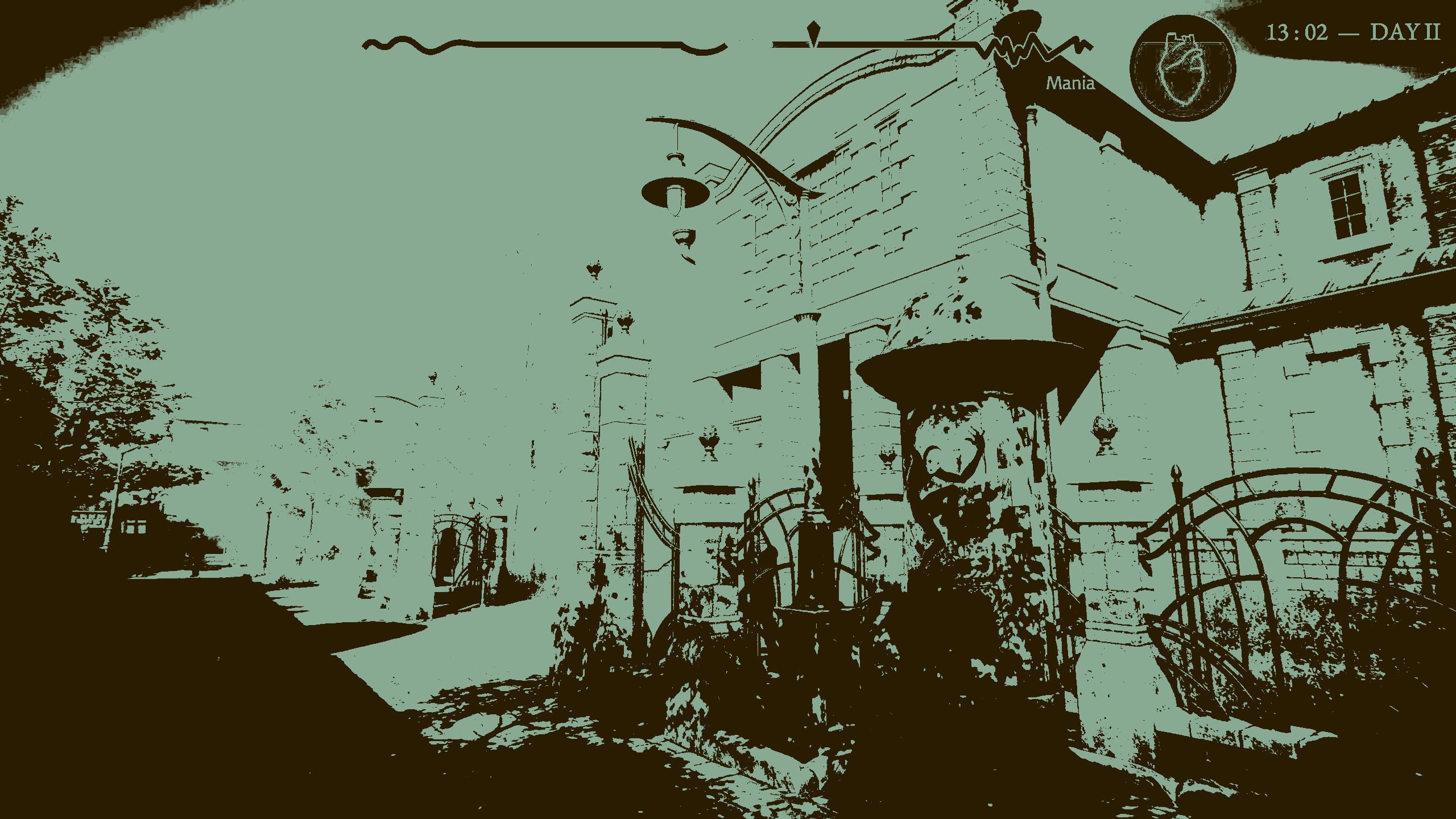
The Bachelor, Daniil Dankovsky, is an idealist. He yearns to defeat death, not in the one-promised-day way that Christ did, but with the cold certainty of science. He wants death to be found legally deceased. Yet, he carries a gun in his pocket, a debutant, the favored gun of assassins and housewives. It could load two shots, but it only has one. It's hard to miss when you are aiming at yourself. This is one of the dualities that defines Daniil. He's a city boy of realities caught in the country town of dreams. A man who dreams of immortality who carries a pistol in case he can't catch it. A doctor obsessed with theory, trapped in a town that demands praxis. Like his companion protagonists, Daniil Dankovsky has fates written in duplicate and triplicate. Though he is the most rational of them, he is also the most mad. The Changeling, a magical girl in the most literal sense, takes the supernatural elements of the plague at face value, thereby evading the arcs of denial which both the other protagonists must overcome. The Haruspex of Pathologic 2 grows weary and hungry, while Daniil flits from heart-pounding mania to sinking, slowing depression. Daniil presents himself as buttoned-up, but inwardly he is far more tortured. For Daniil, as much as for any human being, the mind is the body.
Since the beginning, Pathologic has had an interest in modeling things that ludic systems struggle to represent. Pathologic 2 and its predecessor were both punishing poverty simulators. Hunger, thirst, and exhaustion threatened their protagonist as much as any plague or gunshot. Time was an enemy, for the more it ticked, the less you could accomplish. These games thrive on desperation. In some ways, the latest entry is no different. Yet, the desperation is, for the most part, not physical. Sure, thieves and plague-ridden beggars can hurt the good doctor. But Daniil is desperate for desired outcomes: the right deaths instead of the wrong ones, the true diagnoses rather than the incorrect ones, the truth instead of fiction. For him, time is parchment one can scrape off. With the sharp currency of mirror shards, mercy killings, and completed favors, Daniil can rewind the clock, select what plot lines to reset and which ones to leave alone, like a jaded writer killing and resurrecting their darlings. It is this idea that fuels the game's economy and which can end Daniil if he is not careful.
In a tangible way, this makes the game about obsession in a way that other entries have flirted with, but not fully embodied. Most people have replayed a conversation in their head, knowing more fully what they would have said with more time to think. But Daniil can turn the world over for such conversations, can return to a week prior thinking that one new turn of phrase might open one new door in the future. It's a metacommentary on the series' past. Players cannot reload old saves, but they can time travel, albeit at a cost. It makes the savescumming players indulged in prior games into a tangible part of the world. The town is a machine, one which you can tune to your heart.
But the town is also a body, a great bull with running rivers. Any body has a membrane, a boundary which separates it from the world outside but through which the world can enter. In addition to his more-or-less typical health meter, Daniil swings between "apathy" and "mania." When balanced in the middle, Daniil moves normally and takes no ill effects. When manic, he rushes with inhuman speed and his heart suffers for the effort. At its worst he cannot speak at all and might drop dead. When apathetic, he walks lethargically and the precious currency which Daniil can use to rewind time drips out of him. He no longer cares about the time he is wasting. These states are psychological, yet the primary way the player experiences them is within Daniil's body. They are a reminder of his human frailty. Every slow heartbeat turns him back to apathy; every harsh word to mania.
Yet, these states can also be managed, driven to perfection (or at least to what is needed). The most obvious way is drugs, to which Daniil has plentiful access. Yet, with each use they become less effective, grow a festering addiction. The sensory input of the world is more reliable. Push at a water pump or kick at a trash can to raise Daniil's energy; contemplate a corpse or play with a child's toy to make him care less. In one sense, Daniil is frightfully emotional. The wrong word can drive him to prepping the gun he always carries with him. In another, he is only calculating. To the uninformed eye, Daniil does things that might seem nonsensical. One could imagine a bystander thinking, "why did that doctor just knock over a trash can?" Yet, within Daniil's body, these things are perfectly logical. They tune his body towards the way it should be.
This is all a long way of saying that Daniil Dankovsky is crazy. This is not pejorative, so much as diagnostic. He has such a love for the world that the idea of even one soul perishing is painful and such resentment that it would be better to kill himself than stay in it. He scoffs at the supernatural manifestations of the Steppe, but believes, with kind of a religious faith, that death is mortal. He questions his own sanity when he witnesses the Shabnak, a corpse woman manifestation of the plague. Yet he still builds a weapon to banish it, each and every day. These are dualities, contradictions sure, but they are also madnesses. The inquisitor asks Daniil whether there was really a Shabnak. Did Daniil not simply indulge the legends of the Steppe and kill innocent women accused of spreading the plague? Or is he merely recreating a burning he witnessed on the first day in the town? He can deny or contemplate these explanations but there are no answers, only one fact. When he clears the plague's mist, he can hear a woman screaming. Whatever the real answer, there is no way out. Daniil sees things "rational" people do not.
Unlike Bloober Team's Silent Hill 2 remake or either Hellblade, Pathologic 3 does not have trigger warnings. Its credits have no sensitivity consultants. Its marketing material does not boast of its adherence to the reality of mental illness. In fact, diagnosing Daniil might prove a little tricky. Bipolar disorder would be the obvious one, but his sensitivity to light and sound and his fixation on a specific set of pet projects could indicate autism. Pathologic 3 takes place in the past, though naming exactly when and where would be difficult. But it would be reasonable to assume that it was before there was ever a Diagnostic and Statistical Manual of Mental Disorders. Perhaps thereby in a time when madness was still a kind of wisdom.
The Bachelor is not the only mad inhabitant of the town. He may be the most diagnosable, thanks to the others' connection to the folk magic and indigenous traditions of the area. Eva, the caretaker of the Stillwater house, where Daniil resides during his 12 days in the town, considers herself both alive and dead, like how light is both a particle and a wave. Her suicide on the 10th day is her testament to that truth. Simon Kain, the seemingly immortal patriarch of the town, brought the plague to it, so that the town could weather the future. It remains unclear whether it is out of mercy, panic, negligence, or, yes, madness. Daniil is merely the one whose body the player halfway inhabits, the role they take on.
Although Pathologic 3 and its predecessors work over all these madnesses, there is always wisdom to them. However strange the Steppe dwellers seem to the civilized occupants of the capital, they hold truth that speaks to the heart of the disease. The Bachelor, the Changeling, or the Haruspex must incorporate them to succeed. This is not so much a thesis as it is a fundamental fact of the world. In hallucinations, in dreams, and in the things that the rational would write off as irrelevant, there is something real. There is a fundamental mystery which punctures the heart of human living. The people who are mad do not always wield it well and they are not always good, but madness itself is never wrong.
The idea of ludonarrative dissonance, at least as it is commonly used, relies on a kind of absurdity. It presupposes that the events "shown" through play are quite literally real. This feels like a uniquely videogame problem. Videogames, with their roots in simulation and computer modeling, tend to present themselves as at least a reality, if not realistic in themselves. Yet this cannot be true. Arthur Morgan never needs to go to the bathroom. The days in Red Dead Redemption 2 are just 48 minutes long. All videogames are abstracted. It would be an inane question to ask whether the town of The Cabinet of Dr. Caligari really looks like that. Yet, videogame criticism has been asking questions of such inanity as long as it has existed.
Pathologic generally, and 3 in particular, lean on subjectivity in a way that is rare for videogames. If Daniil runs while his mania is high, you hear the sounds of a film projector accelerating; when he is drowning in apathy, scratches and film grain appear. Clocks are safe havens where Daniil can time travel using money he raided from smashed mirrors. None of these things are literal. They cannot be. But yet, what is? At the end of each of Pathologic 3's 12 days, the whole sky turns into the ceiling and stained glass of the theater, while actors play out scenes next to the Stillwater. To Eva, Daniil asks if the actors and their racket bothers her. What really happens in Pathologic 3, and what is just Daniil's perception or the fragmenting of his memories? But what does that question matter? It's the map that matters, the abstract picture that the game creates.
For all the things that Daniil Dankovsky is, he is first and foremost not real. Still, he is no flat symbol or thin surrogate. It is a fact that for the vast majority of human beings, experience is elusive. Details, like how a tree branch spiraled across the sky or the exact shape of the wrinkles on a stranger's face, are impossible to recall. It is often only exceptional experience which can draw fragments into horrifying clarity. What we remember of a novel or a game or a film is feeling. The product of its multitude details is untouchable. It is that feeling alone which reaches into immortality.
The entirety of Pathologic 3 takes place in retrospect, as Daniil relays his story to an inquisitor. It is retroactive justification, tall tale, and confession. Yet, even with some control over his narrative, perfection remains elusive. He doubles back on himself, tells the truth and then tells lies, recalls important information too late. This is because cracks are what let the light in. A truth that Daniil affirms every time he breaks a mirror. "Once Dankovsky, now a thousand Dankovskys." The whole game is a portrait and the player is both sitter and painter. The result must be incomplete. It is made up not of symbols, but shards which construct a picture no human being has fully understood. If there is any truth it is only us, with all our jagged edges, that can reach it.
***
Grace Benfell is a freelance writer based in Chicago. She is the author of Killing Our Gods: Essays On Religion, Christianity, And Video Games. She co-edits the criticism journal The Imaginary Engine Review and co-hosts the survival horror podcast The Safe Room. In her spare time, she writes horror fiction about bad Mormons and organizes with the Freelance Solidarity Project. Her work can be found at The A.V. Club, The Wand Report, Edge Magazine, on her website, and elsewhere.