Song lyrics from: “Parachute” by Caroline Polachek
“Awake from a dream. One that started as a nightmare. Like a war, so extreme it erased itself from my memory.”
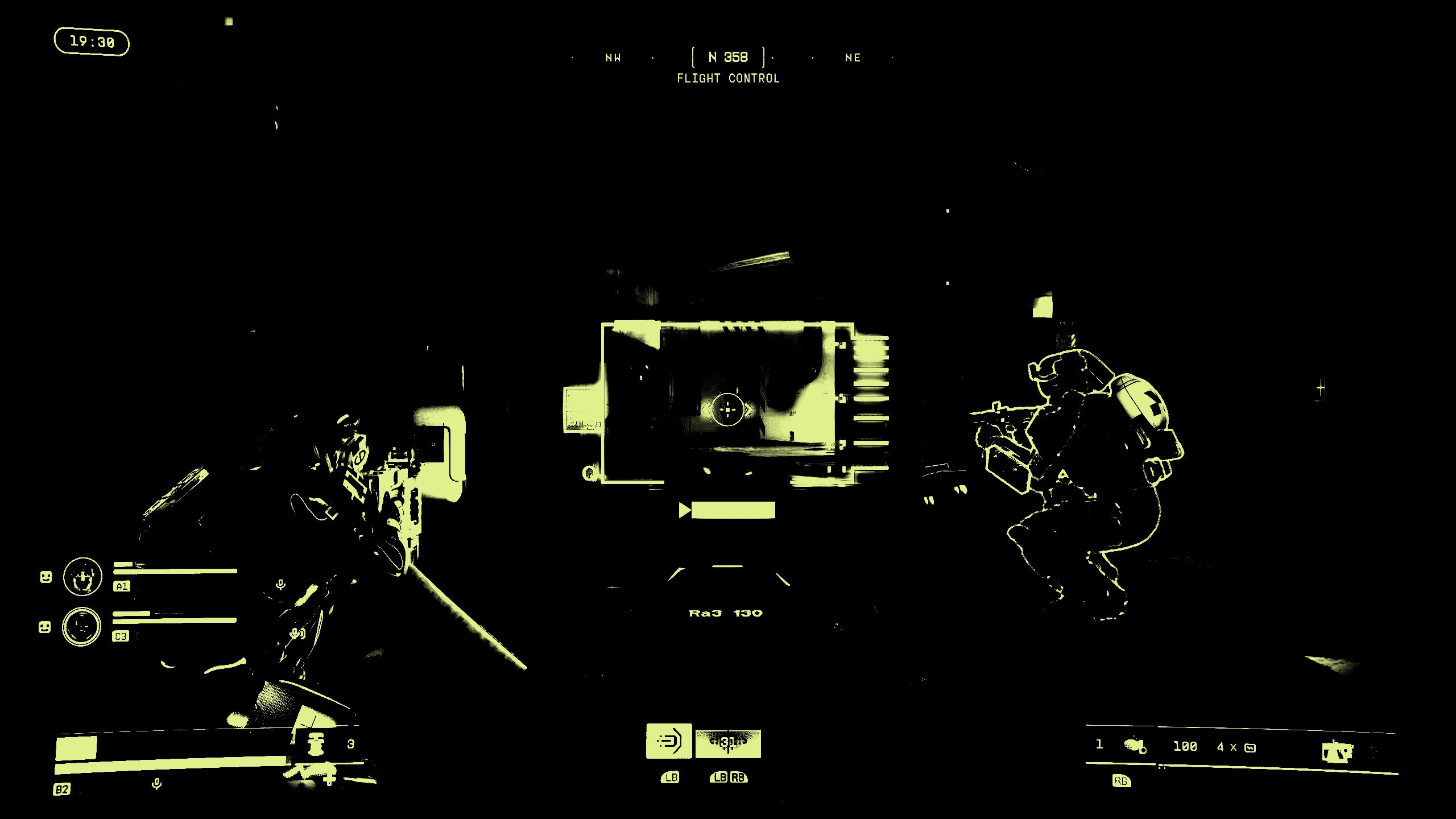
Runs in Marathon end swiftly. You’ll sprint around the corner with a backpack full of loot and collide with an opposing runner’s shotgun blast. You’ll dash across an open field for a vanishing exfil, hear the crack of a distant rifle, then crumple to the ground, digital static blanketing your vision. Then: the victor, crouching over you, with a drawn and deadly-looking blade. Then: the signal disconnection, 404, please reload this web page. You are ejected from your frame, back into the liminal space where you exist between matches.
The tension that had built all run dissipates here into warm disappointment. Shoulders unknit, teeth unclench, hands relax their grip on the controller. There is a murky calmness to the extended purgatory of the loadout menu. Muted techno drones in your ear as you sort through stacks of shields and ammo types, as you trade out weapon attachments and compare implant stats; fantasying the perfect run that this perfect loadout will produce.
On the stage of the main screen, your chosen shell, with its baked-in personality, cycles through poses, preening before the one-way glass that separates it from you. This space becomes as deeply familiar as it is ephemeral. You cannot stay here forever, a disembodied consciousness, held in the virtual arms of your remote handlers, who croon motivational lullabies into your sleeping mind, as you float in the eternal inorganic.
///
Here’s where I jumped from the airplane without questioning it. The curve of the coast of Los Angeles spreading itself below. And blooming overhead, the parachute. I’ve got to trust it now, oh.
No. Wake up now, runner.
You must leave this space, leave Nona’s warm cocoon, Gaius’s spreadsheets, Vulcan’s static-raked hellscape. You must make landfall so you can fight again, so you can die again. The loadout screen, as safe as it felt, wasn’t living. There was no air to breathe up there, no blood to taste on cracked lips, endless, effervescent sensations broadcast over low-latency into your remotely floating brain. To live, or at least, to approach something like living, requires opening yourself up to pain and death.
“Your gear is at risk. You will lose all equipped gear if you exit or disconnect from the game.”
This is life, as harsh and as painful as it may be, as pressured and restricted into scraped-out channels as it is. Everything organized into specific tasks and objectives, monitored by the moneyed interests that charge you for every beat of your heart, every compression of your diaphragm. That dangle the carrot of a fat paycheck and a stable bank account, watching as you trip and fall trying to grasp at it.
You’re bringing your good guns this time, throwing good money after bad. This time will be different. This time, you will get what you came for. You will defend your stake, drive off latecomers as your exfil charges. You will succeed or die trying. You will die, better. Your death will move something, even if all it moves is the stock price of a publicly traded corp half a lightyear away.
///
Change in the wind. And I’m drifting from the crescent. Pulled farther out from the shore than where I can swim to it. And blooming overhead, the parachute. I’ve got to trust it now, oh.
We know what runners are. But why are runners? What drives someone to surrender their organic form, lose all memories of who they once were and send their minds into deep space to be enthralled by lifeless, eternal corporate gods?
A runner is nothing more than the player, personified.
Videogames are spaces that, at their best, offer a taste of something beyond the normal repetition of everyday living. They offer something apart from life, with its million indignities and responsibilities. They offer the promise of adventure, of battery acid in the belly, of clenched jaws and screams of triumph or comic dismay. For a glimpse of this promise, the runner, the player, projects their minds beyond the bounds of their life, into another place: to play among the delicate ruins of another’s dreams, the coded worlds someone else spun together and wrapped in glorious skyboxes. The dreamers are gone, or watching from afar as their windup toy continues its meandering path without them. All that exists now is you, and a million others like you.
///
Closing in on the sparkle of the waves. Go on, take me, it will feel like going home. Go on, take me, I’m not afraid to drown.
Completion is extinction, the only alternative is abeyance, through repetition. Freud wrote in "Beyond the Pleasure Principle" that “the aim of all life is death.” In living, in fighting to carve out a life, you dive headlong, heedlessly, towards your reward: dying.
But not yet, not like this: backstabbed as another runner exfils with your hard-earned loot; bleeding out, too far from your squadmates for a revive; torn apart, headshot, bludgeoned, and left for dead. You want something better; you can imagine something better, waiting a hair’s breadth from your outstretched fingertips.
In her critique of Freud’s essay, philosopher Alenka Zupančič wrote: “the death drive is what makes it possible for us to die differently. And perhaps in the end this is what matters, and what breaks out from the fatigue of life: not the capacity to live forever, but the capacity to die differently.”
The Tau Ceti colonial project that was the inciting incident behind the events of Marathon was based on a false hope, a plan to start over, to escape the decaying orbit of a moribund humanity. Flung beyond the bounds of the solar system, the Marathon ship was sent to grasp at life, borrowing it from an impossible dream of the future. The life its crew found brought only death. It came awake inside their bodies and tore them apart.
As a runner, here to pick among the corpses, you embrace death, and through dying, through the simple truth of a gun, the splash of blue bile, the shattering of limbs, you find life, or something close enough to it. No wonder you’d sell your soul for a taste.
///
What is this, pulling me back the other way? To strip malls, highways, and treetops. Landing on the soft ground.
Death waits patiently. But something pulls you back: to friction, to loss, to bruised egos and endless self-criticism. The chase for the high allows us to accept the lows; to see those waves and say “not yet.”
From the echoing silence of the lifeless shell, life erupts again, all fizzling static and foolish hope.
***
Yussef Cole, one of Bullet Points’ editors, is a writer and motion graphic designer. His writing on games stems from an appreciation of the medium tied with a desire to tear it all down so that something better might be built. Find him on Bluesky as @youmeyou.