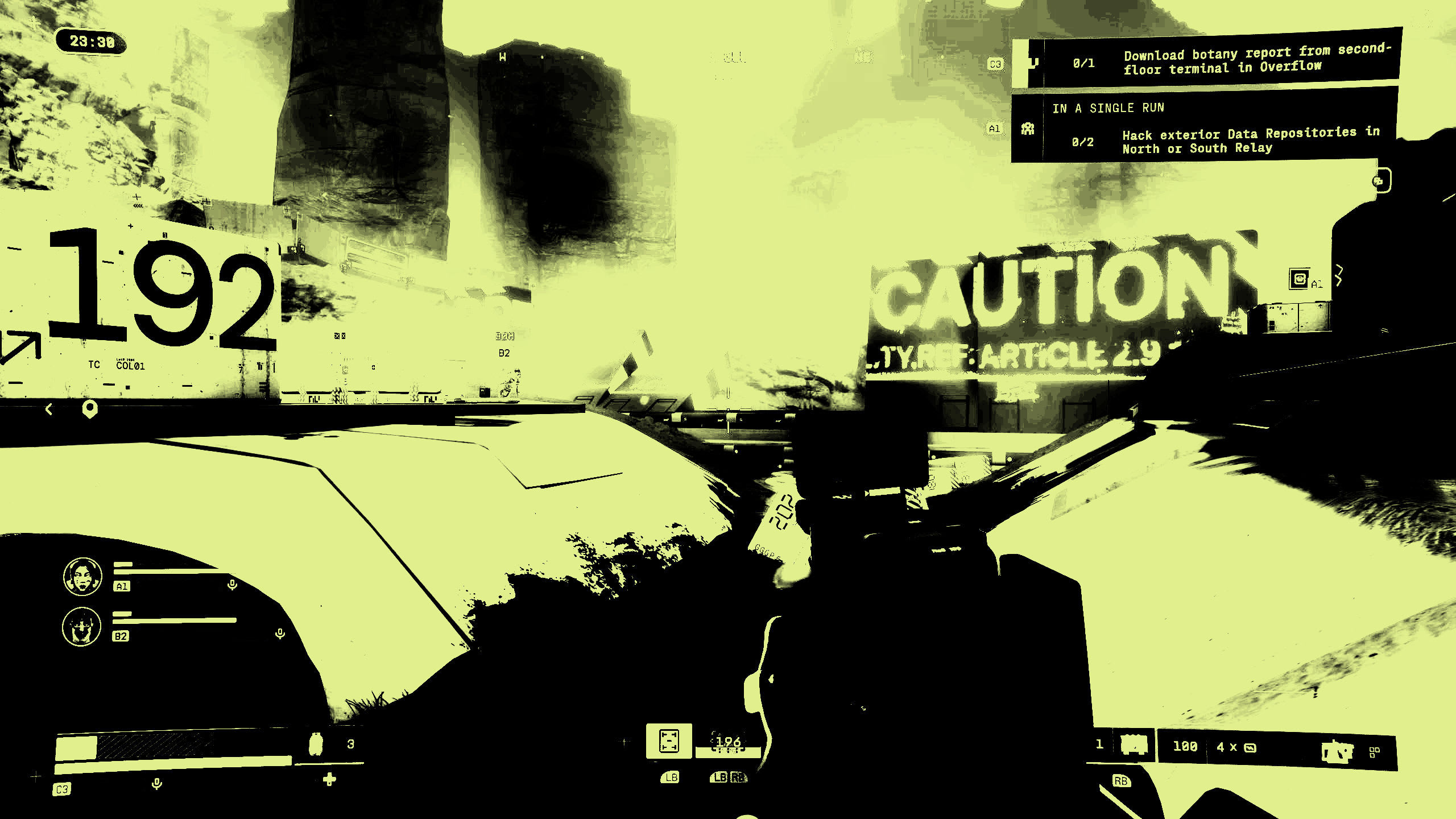
it's the shimmer in the clouds as the bullet sails across the pallid gunmetal sky ... the stillness dissolving in the mist, the wind making way for the lead ... it's that sound in the air even before the glass shatters behind me ... that instant before the whole room feels different ... like a rave in the underpass, seconds before it's engulfed by the floodlights of a police van ... and there ... it's that tremor in the earth, crawling across the grassy plain ... beneath the copse of sullen trees, the furtive muttering of their branches ... that creaking in the walls lining the relay station, setting everything into motion before i can even see it—
i'm suddenly hit for what seems like a lot of damage.
"ope, okay," rabbit says. "let's get the fuck out of here." she shoots the window across from us with her assault rifle and vaults through it. right out into the open, into the silver expanse—into whatever terrifying world delivered this warning shot to us.
i'm already following her. i don't even think to heal.
as we dash across the platform and jump over the edge of the relay station, bullets at our heels, i get a brief glimpse of our surroundings. ahead of us: fog draped over a scraggly ravine, a flock of red-beaked birds perched on a wrinkle of bedrock. behind us: south relay, a decrepit mess of industrial buildings dressed in unnatural hues—hot orange, neon yellow-green, the sterile blue of a chlorine-rich swimming pool. then the relay tower itself, studded with weather balloons and bent in a tortured pose, failing to touch the sky.
this is only my second round of marathon, and the world of tau ceti iv is still so alien to me. what i know is that we're runners sent to retrieve salvage from an alien planet, its surface blistered by failed attempts at human colonization. to traverse tau ceti, we rent out "shells"—cybernetic surrogates for our unmoored minds—and sculpt them into vessels for the desires of conniving megacorporations. earth's governing body, the UESC, has deployed squads of militant androids to safeguard the ruins, as well as the corporate secrets lurking within. we are given endless lives to expend in order to fulfill our contracts; upon death, our consciousness is transferred to a new shell.
i also know that we're deployed in an area called "perimeter." within twenty-five minutes, we must burgle the grave of a dead space colony, avoid getting murdered by robocops or other runners, and exfiltrate at one of a few designated stations. if we die, we lose everything—everything we've gained, and everything we've brought. well, everything tangible, anyway.
"you run faster with your knife out," she says.
i'm already several paces behind her. she doesn't even need to turn back to confirm it.
"oh, right, thanks."
by now i've learned that many of marathon's inner workings, from foundational mechanics to narrative throughlines, are left obscure. so when it comes to the basic conditions for survival, i've given rabbit the tacit permission to treat me as if i was literally born yesterday. any sliver of information is valuable brain food to a marathon baby like me.
at first, perimeter feels familiar. the grass is green and the sky is blue. then the uncanniness starts to settle into the edges of your view: an unusual volume of yellow fungus, for example. cryptic drawings scrawled onto the walls of an air duct. strange sounds from the loudspeaker. the machines bark like animals. sometimes it feels like there's something else hidden in the wind. the rain patters indifferently on the remains of felled runners, coating the soil with scattershot nebulae of blue blood.
even still, i can't help but think perimeter feels oddly earth-like sometimes. when the fog rolls in over the grass, the sight reminds me of san francisco, the city where rabbit and i grew up—our childhood spent walking on ocean beach, the mist spilling over the cliffside, lounging in the cavernous bowels of the ruined bathhouses.
"uh," she says. at some point we stopped sprinting and are now crouch-walking, which means we must be nearby something dangerous. it seems she has another lesson for me.
"yes?"
"you've got a thing about bugs, right? how bad is it again?"
"wait, wh—AUGH!" an insect the size of a basketball shrieks before bursting into viscera in my face.
i've known rabbit for over twenty years. we grew up as boys playing halo—namely, the first four mainline entries, which were all developed by bungie. this might be why marathon, bungie's latest game, has got me feeling so sentimental.
so i'm flattered she remembers my thing about bugs. i tell her she has to clear them all while i hide in the adjacent chamber.
after the last of their nests are destroyed, we continue making our way towards the nearby exfil station. rabbit explains that we should prepare to encounter another team of runners. her shell is equipped with the ability to turn invisible, so the plan is for her to activate the exfil station while i keep my distance. once she does that, we have to wait for a little while, and then she'll give me the go-ahead. a circle of light will appear on the ground, and after someone steps in it, a ten-second countdown will begin before it dematerializes, along with anyone who made it into the circle.
i absorb maybe half of this as we creep up the hillside leading to exfil. i can already hear gunshots from up ahead. we glue ourselves to a wall nearby.
"fuck, it's like you're red," i say. "from roadside. and i'm ... fuck, what was his name? the naive kind of lennie-from-of mice and men guy."
"the kid?" she asks. "at the end?"
"no, the russian guy at the beginning. the one with a pure soul who ends up dying. well, i guess both these guys end up dying. also hold on, you thought i was the son at the end? doesn't red, like, fuck that guy's sister?"
earlier in our run, i'd mentioned that tau ceti reminds me of the zone—the setting of the 1972 novel roadside picnic and its loose 1979 film adaptation, stalker—and she responded as though the analogy were a given. i know, it's fun. it's, like, bungie doing zone fiction.
the zone: a pocket of the earth that's been unsettled by some alien or supernatural presence, loosening the binds that keep reality tethered together. a mysterious realm that maims any visitor who fails to acclimate to its convolutions in physics and logic, filling their minds with devastating epiphanies and abject terror. a neglected petri dish. a carnival of rot. a place that makes all of humanity feel like a bug smashed on the windshield of an unfathomably massive spacecraft.
yet it's also a vast possibility space, a lush wilderness, a "magic circle" that enables play and experimentation. it attracts ravenous dumpster-divers, hopeless romantics, grief-stricken wanderers—people driven by desperation and monomania.
echoes of roadside picnic, stalker, and the zone are palpable across a wide range of modern games: death stranding, control, nier: automata, lethal company, fallout. but even in these early days in marathon, there's something about it that feels especially compelling as an expression of these themes. rabbit can feel it, too.
i've only just begun to see the zone in everything, whether cyberspace or meatspace, but rabbit's been tracking this stuff for so long that she has a term for it: zone fiction. as usual, i find that she's already a few paces ahead of me.
in fact, right now, she's literally several paces deep into the exfil zone, shrouded in smoke, before i can even understand what's happening.
"um," she says. "so, i'd really like to return with this loot i picked up."
"yes?" i say, confused. "and?" i’d assumed that kind of thing went without saying—that we'd probably prefer exfiltration over death.
"so i kind of—well, the circle basically closes in, like, seven seconds, so—sorry."
"wait," i say, still trying to recalibrate. "oh my god. you actually did it. you fucking red-from-roadside picnic'd me." she’s gone when the smoke clears.
frankly, i'm shocked—not due to any personal offense, but because there is still apparently something new to learn about rabbit, even after all this time. she watches over spectator cam as i perish a few minutes later.
it'd be easy to write this off as an example of the antisocial behavior intrinsic to marathon's competitive structure. a less generous version of me might read this as a stark moment of ludonarrative harmony. wow, this me might think, marathon is so brutal it can dissolve a twenty-plus-year friendship within the ten seconds it takes for an exfil station to dematerialize.
but we've been playing gun games together for forever, and if i took everything that occurred within them personally, i doubt that our friendship would have lasted. besides, it's likely that being able to play marathon together at all means more to me than she realizes.
so instead of getting mad, i make a silent vow to surpass her.
///
it's that spasm in the tapestry of reeds lining the horizon ... the trigger quivering at your fingertip ... it's the tender glow of lightning before thunder ... the shadow moving underneath the threshold of the door ... the red dot of the rangefinder tracing your cheek—
the bullet barely misses me. i panic. i'd thought i was appropriately camouflaged—a momentary glimmer amongst the marsh's shimmering mosaic of ferns and lily pads. i’d thought at least the fog might buy me peace. but the panic itself i don't mind.
runners who participate in IRL ultramarathons reportedly experience hallucinations. sleep deprivation populates the racetrack with distortions in reality that range from the absurd to the violent.
runners in the game marathon experience hallucinations, as well. earlier during this run in dire marsh—a wetland zone hosting some of the colony's agricultural research facilities—i'd been assaulted by a torrent of ghostly, machine-like yet upsettingly human sounds while scouting out the basement of a vacant data facility. rabbit later informs me about "digital psychosis," a term bungie's sound designers use to describe an area's density of atonal, unpredictable acousmata.
here, in tau ceti, panic is perhaps the most productive component of fear. it forces you to act before your imagination can fill in too many of the gaps, feeding the dark void of the unknown with dangerous possibility.
i scramble to retrieve my sniper rifle from my backpack. before i peer through its scope, i try to focus all of my attention on the horizon formed by the row of treetops and greenhouses that underlines the sky. it's broken, for a split-second, by something human on the rooftop just east of me. i aim down the scope, fire once, and break their shields. the response—a headshot, delivered like a punchline written in lead—downs me in an instant.
i opt to expire early instead of bleeding out in the grass. i want to avoid the humiliation of being executed from a distance—or worse, the intimacy of a "finisher," in which the enemy straddles your chest and draws close before sliding their knife into your neck. i'm playing solo, so no one is available to revive me.
after rabbit's betrayal, i'd settled on two things other than my resolve to surpass her. firstly, i'd only learn about marathon—its mechanics, its lore—from the observations of my crewmates, avoiding any supplemental material. i also decided to spend a considerable amount of time playing alone in order to become more self-sufficient. i wondered if, one day, i might invert the stalker / rube dynamic we'd exhibited during our first run together.
through these solo runs, i learn how to bend time. i learn that being a good runner means experiencing everything a fraction of a second before anyone else. it means tapping into the schizophrenic logic you'd normally want to keep at bay, entertaining every doubt and delusion that sidles through the backdoor of your head. in order to fully inhabit tau ceti, you need to reciprocate: you have to let it inhabit you. you have to grant it easy access to your amygdala, the permission to stimulate fear before the violence has a chance to take place.
recklessly indulgent pattern recognition. frolicking through meadows of noise. harmony in a broken world. stalker shit.
even in the absence of runners, marathon's maps are convincing facsimiles of living environments. the sounds of the marsh make up a dense canopy of audio cues and ambience, from the furtive rustling of the reeds to the dutiful whirring of the sentry drones patrolling the sky.
but the enemy lives within fractures in normalcy. they do things the robots wouldn't do. they react to things like fear, shock, and bloodlust. they're just like you.
so first you calibrate for a tenuous, zone-specific stillness. you level out the gurgle of the marsh, the bitter grunting of the clankers, the squeal of a tick as it needlessly obliterates itself against a steel divider—and then you listen for fluctuations in the silence. you learn to identify the irregular rhythms that indicate life. a clanker can open a door, but it doesn't have the instinct to close it behind them immediately. nor does it produce inconsistent footsteps. glass, water, turf—all you have to do is listen for the sounds of tau ceti recoiling at our touch.
rabbit's definition of zone fiction includes works associated with the "new weird"—jeff vandermeer's southern reach series, m. john harrison's kefahuchi tract trilogy, china miéville's the last days of new paris—as well as stories by j. g. ballard, jorge luis borges, and philip k. dick.
she observes that characters in zone fiction are forced to confront the physical and spiritual limitations of their humanity. as they stumble through strange meadows and impossible alleyways, the ghosts of the zone emerge to haunt them. reason buckles under the weight of nature, which remains indifferent and inert in its colonization of the once-familiar. marathon explores similar themes, rabbit explains, but with a focus on post-humans—runners shackled to digital immortality, AI corrupted by loneliness and resentment.
dire marsh, like all of tau ceti, festers with signs of overgrowth and disruption. glaring from its center is what the dead colonists dubbed "the anomaly," a reality-warping miasma that leaks from weeping lacerawtions across the surface of the planet. some salvageable records posit the theory that it's a living organism with underground roots that resemble a mycelial network; others suggest the anomaly is responsible for the fungal contagion that overtook the colony, corrupting the inner workings of both AI and humans alike. the sense of digital psychosis is particularly strong when standing next to the edge of the anomaly itself, admiring the tableau of destruction trapped in its glow, the wreckage frozen in mid-air by geysers of twisted time.
like stalker's titular figure—or control's jesse faden, or annihilation's nameless biologist, or "the willows'" gregarious swede—you eventually acquiesce to the zone's insistence on a convoluted dream logic. the strange becomes familiar. the paranoia heightens your senses; the digital psychosis becomes room noise. as you fade into the marsh, you learn how to become less human.
the revelation that the anomaly may act like a mycelial network, emerging from the ground itself, alludes to another question commonly posed by zone fiction narratives, challenging human-centered myopia: how would an alien environment treat humans if they were an invasive species? how would ghosts feel about the burglars who have come to rob their graves?
thermal scopes obliviate the earthliness in dire marsh, submerging the scenery in radioactive violets and blues. somehow, while peering down the scope, tau ceti seems even more alien than before, flattened into a crisp bitonal plane. but humans, carrying bright and entropic heat, burn holes into the ultraviolet forest. your mind, seeking order, urges you to rid them from your sight.
///
it's in the false birdsong freckling the wind to the east ... the curl of feedback seeping from the loudspeaker ... the hot blush of chaos in the corner of your viewfinder ... it's the specter of a drum tucked into the gaussian curve of a reverb trail ... it's the sound of the electromagnetic radiation from her microphone, sizzling in your ear ... the jittering frequency that follows you from call to call—
cascades of fiery debris rain over the surface of outpost, marathon’s third map, at regular intervals, resembling something like a natural weather condition; you later learn that it's actually the result of a malfunctioning “cloud seeding” system, damned to a humiliating eternity of hellfire. the artificial twisted in an imperfect mimicry of the natural.
sometimes, the continuous night makes the map feel like a house in a horror film. flashes of lightning illuminate the remains of a smashed window—a brief bit of environmental storytelling that confirms we're not alone.
i'm crouched in a corner with a knife. the footsteps get louder—they're running. they're probably prepared to face someone. but are they prepared to face me, right now, as i lunge from around the corner—
"fuck!" the knife downs them in one go. it's a rook—the detritivore in marathon's player food chain. i always feel a pang of sympathy when i put one down, though the sensation numbs with time. i finish them. "got 'em. rook, so it's probably just one."
"nice," sparrow says, relief in her voice.
these days, i'm frequently in crews with sparrow, someone rabbit met on the internet. rabbit has started gathering marathon players—mostly other weird gun girls like us—in a discord server.
as the most experienced runner i know, sparrow has a lot of wisdom to offer. she's often the voice of reason on our runs, advocating for patience and concrete decision-making. she respectfully warns me and our crewmates not to be generous with one another, an honesty i find oddly liberating as someone who’s used to asking for permission any time i want to pick up something valuable.
she mostly plays as a thief, which synergizes well with my toolkit as an assassin; we both favor silent entrances and sudden escapes. i also discover that she's a fan of otherside picnic, which is promising. we develop some chemistry as crewmates over the course of a few runs.
part of it is that we share a similar zone logic. we agree that, essentially, once you've run all the "prisoner's dilemma" simulations and applied your ethics to all the math, the most effective modus operandi is always to react rather than act. information is, above all, the most valuable resource in marathon. when colliding with another player, giving any detail away— your location, your loadout, the tone of your voice—is putting yourself at a disadvantage.
"if they present friendly, then i'll be friendly," sparrow says.
"but i'd still prefer it if they walked ahead of me on the way to exfil," i say.
"one hundred percent."
you develop a dialect. every crew probably has one. the random generation of map elements causes you to speak in prophecies and probabilities. you learn how to synthesize a dozen deaths into a single insight; you say, as if in a trance, "sometimes there's a medical cabinet here." the UESC are “bots,” “clankers,” “AI.” some shorthand terms— e.g. "smoking" instead of "throwing a smoke grenade"—are so common across gun games as to be intuitive. others are accidental; shortly after i start referring to certain UESC transport drones as "juicy galaga UFOs," rabbit does the same, and we never think to reinterrogate it.
it only strikes me partway through a duo session with sparrow that this is the first time i've ever played a game alone with someone i met over the internet—who i met within the game we're playing, no less.
truthfully, i wouldn't be playing this if not for rabbit. most of the hours we've spent shooting each other in a videogame belong to halo 3 and halo reach, which we would exclusively play split-screen with one or two other boys while sitting cross-legged in a bedroom twelve blocks from my house. this was the basis of my understanding of the gun game as a private world, ripe for experimentation and self-expression. sometimes we'd just dick around in the level editor and spend hours treating our half-assed maps as mario kart tracks.
but gun games have changed a lot in the intervening years. arma and dayz inspired shooters with higher stakes—minimal HUDs, scarce resources, bullets that kill you like they would in real life. battlefields expanded into open worlds large enough to host a hundred players. matches obtained a telescopic structure, collapsing agoraphobic expanses into tight labyrinths of corridors. elsewhere, fever dreams of doom stirred a dormant need for speed. crouch-slides and wall-jumps made levels feel like butter. hero shooters emerged, introducing gun games to one of the most unfortunate exports from the MOBA genre: an impulse towards intra-team toxicity. the sepia-toned, tacticool aesthetics of the xbox 360 generation cursed some players with a fixation on military realism. basically, the humble deathmatch had lost its appeal.
then everything was thrown into the melting pot. gacha games quietly colonized a lobe of the internet's hivemind. the internet grew gaudy with the aesthetics and mechanics of gambling. roguelike designers, in pursuit of more efficient dopamine dispensers, adopted the visual language of the casino. with the house breathing down the back of your neck, going all in becomes the only logical move.
meanwhile, at some point when we weren't looking, garry's mod birthed the backrooms. traces of zone fiction are everywhere you look: oddities amongst mundanity, haunted ruins, slow-burn body horror. SCPs and creepypastas persist as mythmaking engines, elevating terms like "anomaly" and "entity" into the public consciousness via roblox games and webshows blanketed in layers upon layers of CRT scanline filters.
thus, the extraction shooter was born. a complex hybridization of systems that borrows from both the deathmatch and single-player survival. the very title of escape from tarkov made the genre's roots in zone fiction clear; the game’s tense atmosphere and punishing mechanics directly recalled the S.T.A.L.K.E.R. series of survival games. as tarkov matured, capitalizing on a belated ascent to twitch's front page in 2020, so too did the extraction shooter, evolving to encompass both dark and darker and arc raiders. the "player versus player versus environment" format produces unique frictions, enabling complex emergent dynamics. it's tailor-made for a playerbase turned jaded by two decades of gun game antisocializing. the more afraid you are of your enemy, the more real and alive they feel, even as some vague impression in the implacable darkness.
throughout these outgrowths and transformations, i mostly abstained from playing gun games online. i didn't have skin thick enough to withstand any game that forced me to verbally interact with strangers. most of the other weird gun girls i meet through marathon tell me they’ve had similar experiences.
a part of halo's success stemmed from the advent of xbox live and online multiplayer. though it was hardly a surprise, every lobby was full of boys, some of whom would fill the room with their dark and fickle interiorities. listening to them argue was disturbing and depressing. i missed the sense of shared presence characteristic of split-screen multiplayer, as well as the opportunity to build upon your understanding of a consistent opponent—the blind spots and giveaways that your friends aren't aware of themselves. but online lobbies seemed too bleak to ever foster that between strangers. online matchmaking, paced like speed dating, created little incentive to truly get to know your enemy. then 2014 arrived, and everything got even worse.
i sometimes get glimpses of this sad, pale world rabbit and i left behind when filling crews of strangers. boys being boys. eventually i stop playing with strangers. rabbit's the only other runner i know who's still willing to do that, though i essentially start forcing her to turn crew fill off when it's just the two of us.
by now, i've well surpassed rabbit's rank. this isn't a function of my skill level or anything; it's simply that i'm depressed and underemployed while she's depressed and getting a doctorate in molecular biology. meanwhile, i got a bachelor's in creative writing (against pretty much everyone's judgment) and haven't been back to school since.
i can't help but think that this must inform the difference in our relationship to zone fiction. rather than vandermeer and harrison, i entered tau ceti with a greater awareness of the zone's influence over lesbian comics and yuri (“girls’ love”) manga: e.g., tsukumizu's shimeji simulation, freya jn's dead horses, and iori miyazawa's otherside picnic (which, incidentally, rabbit introduced to me, though she hasn't read it herself). in these stories, the miasma that separates the zone from the rest of the world is laced with pure, unadulterated girls' love. a sensual language of silence, distance, and semi-automatic rifles.
during pauses in the action, i want to ask sparrow about otherside picnic. i've told her half of the truth, which is that "otherside picnic saved my life." but we aren't close yet, so i've avoided telling her the whole truth—"last year, i sort of lost my mind, and then otherside picnic saved my life"—out of fear of appearing like i'm trauma-dumping. i'd like to think i'm learning from past mistakes, even outside of tau ceti.
so instead, one night, as we stare at the loading screen, i volunteer: "how far did you get into otherside picnic?"
"oh, it's been a while since i've last checked in on it," she says. "i think the manga had basically just gotten to the yuri."
"well, wait," i say. "i think i know roughly which moment you're talking about. but also, i mean, to be fair, the yuri is very much present the whole time."
"listen," sparrow says. "i've read the fucking interview, okay? i know the yuri's there. but you get what i'm trying to say."
then we load in and instinctively survey the map, cutting the conversation short. "so, bio-research arms lockers first?" i ask. i tell myself i'll just ask her the rest later.
the subject of the interview in question is iori miyazawa, otherside picnic's author. the interview (technically a two-parter held across two sessions in 2018, one at a science fiction seminar and one at a talk about heisei-era yuri) is arguably required reading for any self-respecting himejoshi. the interview made such an impact that fans immediately produced amateur translations for non-japanese readers. when i first read it, i was struck by miyazawa's clarity—not just about the state of yuri fandom, nor the genre's literary virtues, but about what it means to be alive.
in the interview, miyazawa details an emergent form that he calls "yuri of absence," which he describes as the idea that "emotional scenery is already yuri." this exchange goes into detail:
interviewer: so it's like the cover of chapter 9 of otherside picnic, where the two girls ride on a farming vehicle, and a boundless meadow is around them ... you're saying this is yuri.
miyazawa: yes. now remove both girls from this scenery.
interviewer: right.
miyazawa: a rusty, decaying vehicle is resting on top of wheel tracks.
interviewer: right.
miyazawa: then you imagine that one day two girls were there ... isn't that already totally yuri?
he observes that science fiction tends to put "image" first—scenery, world-building—while writing yuri demands a focus on its characters' interiorities and relationships. in the interview's most notorious passage, he says: "you could say that 'yuri made me human.'"
the concept of a "yuri of absence" is innately hauntological. it gives shape to the negative space in which womanhood flourishes, in which girls can use the bones of broken systems to flirt with alternate realities and invent new ways of being. it honors the strange and subaltern avenues through which girls are forced to express their feelings for one another, from sisterly love to erotic desire. in dead horses, discerning the location of the zone's wish-fulfilling house requires forming a window with your fingers, peering through it, and intuiting an "absence" in the air. absence is the true shape of girls' love; there will always be new ways to capture and experience it.
while crossing the swamp with sparrow, it occurs to me that marathon is rich with absence. through curtains of fog and silence, it enforces a deliberate pacing that requires runners to truly listen to one another.
i can relate to rabbit's interest in marathon's greater world-building project, as well as its attempts to probe the further reaches of zone fiction's themes. but while watching stalker, i'm less intrigued in the zone's metaphysical logic as i am in whatever's going on in the stalker's head during his first few minutes in the zone: that scene when, moments after warning his compatriots about the unseen terrors mottled across the plain, he dives into a private patch of tall grass, accepting the zone into his lungs with each deep breath.
there's something inherently romantic to the moments of contact between a stalker and their zone. i consider romance a capacity for imaginative thinking, a forgiveness for embellished recollection, qualities that allow people to create meaning out of nothing.
marathon excels at cultivating the lonely, haunted atmosphere that allows such longing to blossom, as both a social experience and as a vehicle for a non-linear narrative. the collectible audio log is one of the most time-worn devices for delivering plot in videogames, but it obtains a different gravity in marathon, where lore-related salvage comes at the cost of precious inventory space.
this salvage preserves the calcified stories of the dead colonists, who are given a chance to speak via snippets of stolen documents and recordings. some describe the cruel irony of enlightenment giving way to madness as researchers confront the essence of their findings: that humanity is truly infinitesimal in the sea of the cosmos, rummaging through the remains of technologies it couldn't possibly understand, let alone conceive. "what are we in comparison to everything we do not know?" one scientist says in both fear and awe. before them is the sample of an alien species so complex in its construction that they describe it as approaching divinity.
yet you also find, stowed in locked containers and bodybags, diary entries recited with begrudging honesty; lively conversations between AI during the pubescent stages of their actualization; poetry written on the verge of complete insanity; and, most of all, people desperately clinging to their humanity as they brace themselves against the violent tides of cosmic nature.
this romance is what allows the doomed colonists to strive for a sense of purpose and belonging even as tau ceti's terrors descend upon them. the naive courage required to extract a manifesto from the crude sea of abandoned data and wholeheartedly claim it as your own. the righteous clarity of purpose a person needs to declare this during her final moments, to the fungal growths invading her body: "you can colonize my blood and liquefy my bones, but i figured you out."
it's the thing that plants the goosebumps on your arm when confronting the image of an empty tractor in a vast meadow. the feeling that drives me to find connection in gun games, even as they're haunted by the ghost of an old, discarded life.
so is there yuri in marathon? certainly, there's yuri (as rabbit suggests) in the sight of two shells scissoring during their final moments, bleeding out, on the brink of dematerialization. but it isn't just that.
it's the flicker of silence between two shotgun blasts ... the gap between the streetlights passing your window ...
///
it's the moment of vertigo before you bail out on the grass ... the way the earth breathes as you come to your senses, face in the soil ... the power lines coiling around the telephone poles like sinew and bone ... it's during that last minute of shotty snipers on sword base ... the way the room shakes before she even trains her sights on me ... exposed on the meadow of green within the viewfinder—
one headshot and they're down.
purple shield, vandal with the premium pass skin, crewing with a couple of players in cryo skins. one with a gold shield. the kind of crew that might gank you in pinwheel and say something fucked up over prox chat as they execute you.
i'm pretty sure they're going to be all right after this. so i don't feel bad about landing the next headshot as they self-revive. i'm going to die in less than thirty seconds, anyway. it's final exfil in outpost, and i'm over a hundred meters away. i have no ambitions to exfil myself. this makeshift sniper's perch will be my grave.
if marathon offers anything to say about the human condition, i don't think it's to be found in the cutthroat attitude players adopt with one another, which is at the very least the result of a negotiation between a player's ethics and the flow of the game's violence. yet i feel like i've grown to understand people more by playing it.
otherside picnic is prescient in its imagination of the zone as continuous with both the internet and the collective unconscious. its heroines face shapeshifting, reality-distorting entities who resemble deeply held sources of fear, drawing both from personal memories and from an esoteric pool of urban legends. in the otherside, spirits from shinto mythology mingle with cryptids from 2channel creepypasta threads, hoping to stir the primordial sensations of fear that connect human beings from across generations.
the internet is old enough that lurking through it, combing through its vast fields of information, is the closest thing the average person has to embodying a stalker in the zone. the zone could be a comment section, a discord server, a gun game—whatever form it takes, it's certain to be built atop the ruins of something else. so, too, does it instill a paranoia and suspicion of others in its residents, accelerating the atomization of our zone-bound enclaves. no platform seems safe from bloat and decay.
as the subaltern parts of the internet creep into the edges of our reality—the ongoing permeation of incel terminology ("-pilled," "-maxxed," memes about cortisol levels) throughout the mainstream, the rise of roblox as an incubator for arcane microdialects at the expense of child labor—it's almost as if the zone has learned how to escape the confines of fiction. a stable, legible way of accessing it feels like a dire necessity.
this is why i couldn't possibly be mad at rabbit for something like exfilling without me during my first-ever game with another human being, despite vaguely suggesting during an earlier conversation that she would give me some kind of cue that, if heeded, would result in us both making it out of tau ceti alive.
at this point, being the red in a red / rube dynamic with rabbit is common. it's been several runs since i made good on my vow. meanwhile, i've been meeting more people online through rabbit—other weird girls who think about some of the same weird things we do. all of it is still so new to me.
the truth is that rabbit has been inviting me to spend time with her like this, on the internet, for years, but i was always too insecure to participate. cool girls are intimidating, even when they're nice. when rabbit reached out this time, though, i wanted to be present. otherside picnic had just saved my life—i was so broken and lost, and reading it helped me realize i was traumatized, and that girls' love really does make life worth living—and i wanted badly to talk to rabbit about it. she introduced it to me, after all. she was also the first person in my life to come out to me as a woman; i followed suit a few years later.
when we were teenagers, rabbit used to invite me on "wanders" that charted unconventional routes across the bay, taking advantage of its varied network of pedestrian footpaths. the routes were designed by members of the berkeley path wanderers association, and they ranged from two hours to twenty-four hours in length. rabbit would invite everyone she knew; every time i showed up to a wander i'd be greeted by a different mix of familiar and unfamiliar faces.
wandering revealed the hidden grooves embedded in the surface of the bay. we allowed ourselves to be carried like flotsam to the edges of the city—beaches, railroad tracks, fenced-off lots overtaken by weeds. we floated like specters through the mist. most of the time, we'd talk, but sometimes we'd walk in silence.
spending time in marathon reminds me of those days. we wander through tau ceti and turn its wreckage into urbex playgrounds. we find the routes that seem less frequently trafficked and begin to build memories atop them. we get to know one another under the cover of a smoke grenade, through bleak morse codes of gunfire and footsteps. the further we wander into marathon, the more distant i feel from the part of the world that cannot understand me. only rabbit would really get what i mean when i try to make the clumsy case that miranda july's the first bad man is both toxic yuri and zone fiction.
early in the novel, annihilation's narrator pinpoints the moment she experiences "estrangement"—both from the original purpose of her assigned mission, and from the other members of her team. i have a similar, though duller epiphany as the alarm goes off and the circle of light appears around the exfil station. i don't have anything particularly valuable on me, so i don't care if i die out here. i just want the experience.
but that’s exactly it. i'm not here for the loot anymore. the integers have become large enough to feel arbitrary, though they were arguably arbitrary from the start. if salvage is meaningless to me, why do i continue to spend time here?
why do runners run? why gun games, after all this time? why do we return to the edge of our unfeeling and immutable trauma? i think of the skaters in the sunset district who'd ride down our street—one long slope towards ocean beach, beckoning you straight to the water—and bail out on the grass by the bus stop, just before the busy intersection, watching their skateboards wander into the maw of the ocean, agape and waiting.
***
Pao Yumol writes about games, music, the internet, yuri manga, and being a degenerate. She publishes personal writing and tablature to her blog, goosepimple.moe. Mostly on Bluesky but still lurking on Twitter. She thanks you for taking the time to read her work.