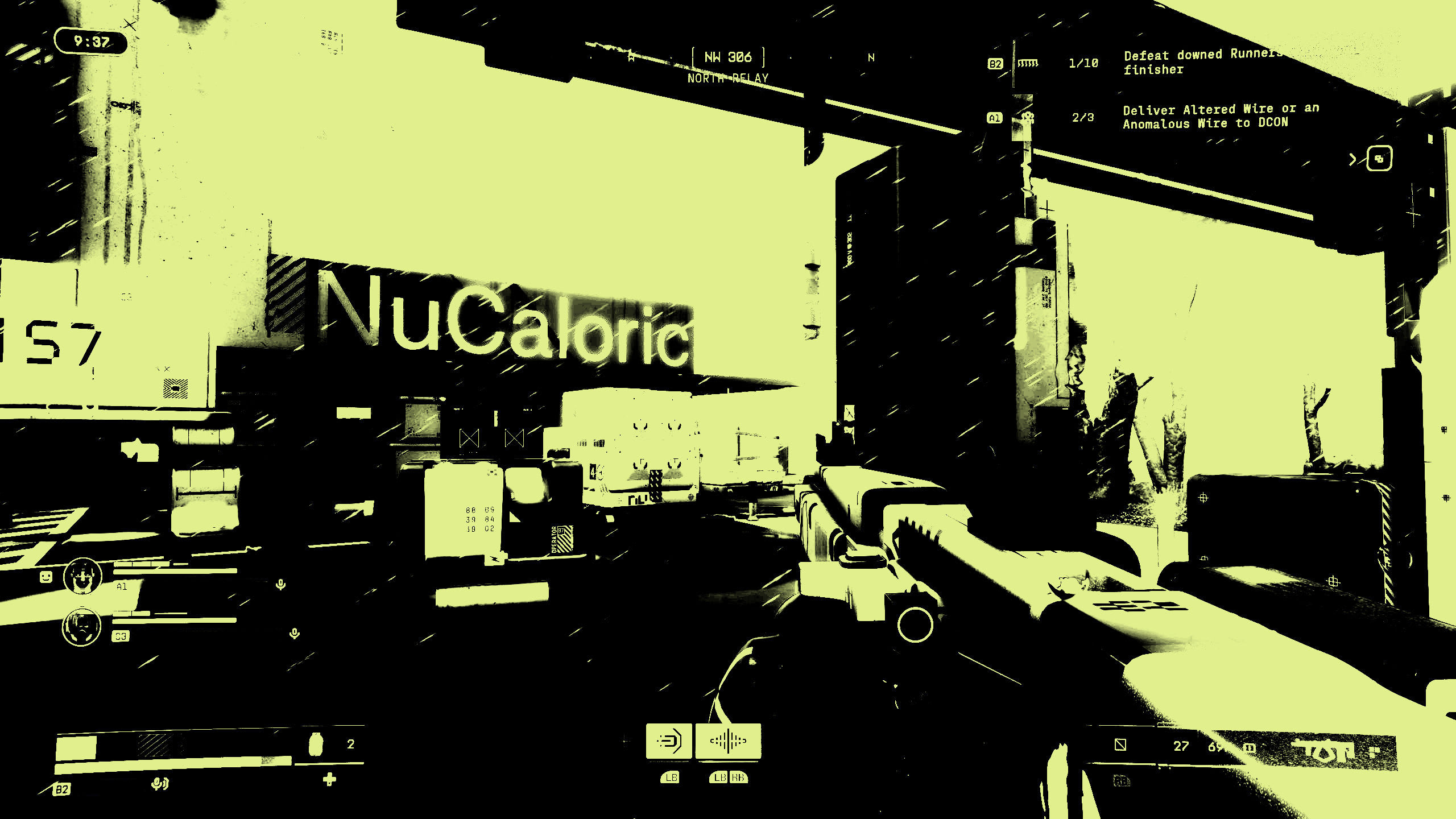
Silk, not skin, is put on the line in pursuit of the run. In this way, each runner can be seen as a tapestry, and their violation, bullet-to-silk contact, is perforation, metal and plastic and fire tearing through weave. The physical boundaries of the runner, the silk shells their cloud-based minds inhabit, are a breathable metaphor, flexing and shifting between futures of trans-humanism; the alienation and dispensability of labor in the age of silicon; consciousness bound to avatars of consumption; vessels of receding memory, self, nationless and atemporal digital nomads and the skin suits they inhabit; tally marks to add to kill-death ratios, prayers to a non-existent ELO. Though the metaphor bleeds through these holes, the metaphor is still, at its core, woven, a textile at risk.
Silk has always had value associated with it. Historians and European travelers named the vast Mongol Empire-established networks of trade routes from East to West the Silk Road. That name would later be co-opted by recent presidential-pardonee Ross Ulbricht for his darkweb marketplace, run on cryptocurrency and libertarian ideals. It was one of the primary goods Britain imported from China through Hong Kong, which they would explicitly colonize after the First Opium War. Further conquest after the Second Opium War, and the First Sino-Japanese War, would puncture it further, "turning the Chinese Coast into a Swiss cheese of more than eighty treaty ports, concessions, and international settlements." Not all for silk, of course, but for silk nonetheless.
The metaphors of perforation are borrowed from academic and historian Quinn Slobodian's Crack-Up Capitalism, where he uses this to make sense of how capitalism "punch[es] holes in the territory of the nation-state, creating zones of exception with different laws and often no democratic oversight." The end goal of this is articulated best by the economists of the Friedman family, a type of free market beyond the borders of democracy that would otherwise stunt it. Milton Friedman, patriarch, would travel to Hong Kong for his CBS program Free to Choose+, remarking on the city as “an almost laboratory experiment in what happens when government is limited to its proper function,” and praising sweatshops in voice over footage for their freedom, efficiency, “lack of exploitation.” From what we know, the boundaries of Marathon's Tau Ceti exist beyond that pesky democracy Friedman had come to realize challenges the free market, and in many ways it resembles the “freedom” his school of thought valorizes: corporate polities among the stars with jagged boundaries of space beholden only to complimentary and competing economic interests, investors, functional monarchies of industry. While governance exists in the form of the United Earth Space Council's military police apparatus, their might is waning, their influence challenged, their reach overextended. One can refer to the history of the UN’s own peacekeeping missions to imagine the effectiveness, professionalism.
Dialogues with the Traxus representative, Vulcan, are the most honest about your role in this ecosystem—the corporations cut through the red tape in pursuit of better margins with runners, for-hire contractors existing within legal grey zones outside of non-aggression pacts and trans-corporate regulations. Your avatars exist to navigate and at times transgress neoliberal globalism, as represented by an intergalactic UN, but exist indentured to corporations modeled after ideology espoused by, for instance, Peter Thiel. You are Blackwater as envisioned by Silicon Valley, soldiers of shrinking fortune—instead of your risk existing in the context of borders, precious minerals, oil, you fight for leftovers, the dregs of the colonies at the end of empire, empty protein packs, colonist feces of some research value, 3D printed flowers. You are asked to kill for the crumbs of a pie long since left to the flies. It recalls Conrad's “An Outpost of Progress,” the desperate, heat-stroked, fatal conflict over sugar. The atmosphere magnifies these small-seeming stakes, the environment exacerbates conflict, and the conflict faced as a runner is ferocious and still hollow. Vulcan praises you for fractional gains on corporate efficiency. You'll have died and died again in pursuit of that praise.
The simultaneous challenge and fantasy Marathon provides, the nuance it offers as real innovation within the space of the extraction shooter and the competitive multiplayer game, is ideological rather than mechanical, per se. This is against trend for Bungie—as developers, their contributions have been more trend-setting than trend-chasing, largely owing to first-in-class mechanics, and oftentimes as equally invested in solo- and multi-player experiences. Perhaps this has contributed to the skewed expectations of the game, to see a game generously fifth-to-the punch generically and without a non-competitive mode offered as an olive branch to Halo campaigners and Marathon oldheads.
And to that perception, much has been said of the game's capacity, or lack thereof, as satire but I fully echo the sentiments of this issue's earlier contributor Lewis Gordon–this game is not satire but au courant. The through line of the game is capital. This is nothing new for games; formal systems of player economics have been meaningfully explored as far back as multi-user dungeons like Avalon or Gemstone IV. But where developers in the nascent MMO-space like Raph Koster, Brad McQuaid, and Richard Garriott might have wanted to explore player-dictated virtual economics as a way of balancing competition, cooperation, and friction without necessitating direct violence (or perhaps as supplementary to the violence), the extraction shooter genre is born from former Spetznaz operators and developers interested in, to some degree, military "realness." The verbs are limited to those familiar to Battle Royale-styled games and looter-shooters. Friction is pure in its violent competition, its immersive qualities derived from the evasive mechanical "crunchiness" of "gamefeel," simpatico aesthetics, physics, numbers, feedback. Player expression is loadout and costume—there are no verbs available that exist outside of this core extractive loop. While some noise has been made with regards to ARC Raiders' more cooperative and laissez-faire approach to player engagement, it is the exception, not the rule—Marathon nearly released without proximity VoIP between parties, and the excellent and comparatively arcade Hunt: Showdown has always been honest about its violence. How, then, does Marathon distinguish itself? Not with increased verbs, options, or expressiveness, but through intent.
So much of this intent is expressed in the manner of not just Destiny's codices, an obvious and apt point of comparison given it was Bungie's last foray into the games-as-a-service space, but to the original Marathon, with its darkly comic and often grand narrative ambitions restrained to text-based terminals found through the levels. Headlining "priority contracts" often pay out their juiciest rewards in sizable portions of prose. Backchannel dealings between Traxus and the UESC make clear not just the degree to which their conflict exists wholly as economic negotiation, but the degree to which they exert their influence into unaligned, anarchist factions like MIDA through plants and patsies. Grim short stories of factory line workers producing increasingly nutritionally diffuse and industrially compromised liquid-cheeseburgers. And strange, sometimes haunting monologues of dying colonists and the unmoored egotism of AI await as rewards for good extractions, being the better runner. Progression is tied to competition. Progress belongs to the survivors. And Tau Ceti IV itself exists much in the way the special economic zones of Shenzhen, Shannon, or the failed Próspera ZEDE, existing outside of traditional governance, instead as exceptional areas of deregulated and (at one point) "depoliticized" commerce. Progress belongs to the bold, the pioneers, the company men beyond regulation and red tape, now, the dead.
Marathon's delivery of this intent is not limited to its presented narrative, but exists top-down in its design goals, its status as a game-as-a-service. To participate in ranked play or the endgame raid, Cryo Archives, requires a minimum "gear ante," a buy-in from your inventory of exfiltrated or bartered arms. This ante system, first unveiled in patch notes from lead designer Joe Ziegler, is the game in microcosm. All systems feed into your worth, and your worth becomes your stake in future success. As Friedman put it (referring to what he called the “laboratory experiment” reduction of governmental oversight in Hong Kong), when people fail, they know “they bear the cost.” Your acquisitions, collected among randomly distributed items in maps, define your build, and your build can just as easily become another runner's. Roguelike mechanics brought to player-versus-player economics. Successful runs feed the ante, raising your net worth, calculating loss and risk for you. The driving motivators for each run: risk assessment, stress-testing, and appetite-whetting.
In pursuit, you run the numbers. What's a good engagement? Is the silk off their back worth the potential loss of this rare item, another chapter in the narrative? Do I exfiltrate with a contract incomplete to preserve this purple mod on my rifle? Do I go back for my team and risk the haul? If this game were in the Armored Core mold, where costs incurred repairing damaged and destroyed mechs eat at your in game currency, these losses might be even more oppressive. Imagine the debt accrued by players if the implied cost of new shells was truly deducted from your account. Even with that bit of mechanical grace, the bottom line is the bottom line. You make and remake these calculations moment to moment. Marathon looks at the ills of today and instead of providing flaccid critique asks you to indulge in play of it, asks if you feel lucky yet. Maybe today you're the shark. Maybe today is payday. An honest game in the age of Kalshi and Polymarket.
All the more grimly ironic, then, that the response to Marathon’s debut has been defined by voyeuristic data crunching with prediction market-inflected schadenfreude. I suppose it invites the speculation. While subsequent patching and balancing done in the game’s live-service model have softened some of its competitive edge, Marathon is still the most directly confrontational in the genre, and while Sony and Bungie have expressed their desire to support the game longer-term, the future of the game belongs to corporate whims.
Still, there is a galvanic quality to this game to those who have witnessed its electrical currents; something about this game, its own speculative mirror show, the sharpness of its science fiction, its basest Darwinian qualities, is resonating. It has beaten the “Concord 3” allegations with its beautiful, strange, repulsive sandbox where success is measured solely in net worth and acquisition. Any so-called law in your way falls to a golden mod on your M77. It's a libertarian wet dream turned festering, hazy nightmare. The bones of old capital picked at by the vultures of new capital. Ticks festering in sleek industrial bone yards, crawling amongst the refuse; metal skeletons patrolling graveyards for reasons beyond your pay grade. You will do this ad nauseum. You will get better, but little changes for the run. Little changes in the world, too. Most modern and future evils are old evils in sleeker packaging. What is Tau Ceti but the stars done up in the Hong Kong method?
///
+ Please forgive how scuffed this video is, and the strange producer tag type clip at the front.
***
Charlotte Lindsay is a writer and critic. Her work has previously been found on The Imaginary Engine Review, and she used to blog via Medium. She’s looking for a new home online for her writing.