I.
007 First Light signals it is James Bond by way of the built environment. Bond, as multimedia signifier, is a spy in the upper echelons of society, and he follows the flows of capital wherever they might move, oil-slicked, lounging in the heat wherever money accretes. When we watch these movies, or, god forbid, read the books, we are tracing the lines of excitement and spectacle around the globe in the way the child of extreme wealth might plot a summer trip—we move from hotel to yacht to luxury restaurant.
This is one of the thrills. We see the things that we should not see. We witness constructions and ways of being that are closed off to the vast majority of us. When we look at them, we align ourselves with an extraordinary worldview; we had to make a special man to funnel all of this world into us.
The international spy genre emerging out of Bond has continued in that mode. Ethan Hunt, Jack Ryan, Jason Bourne, the superheroes who have worn the spy aesthetics, and a host of other piecemeal scenes in 70 years of cinema have all played by the rules that Bond put down. They can do things we cannot. They will threaten and torture and stab and violate and love and die in ways that we do not, and we know it because of the evidence of their alien accoutrement. They sit in chairs you never will. They see sun reflect off glass in a way that you cannot. They taste fish and quail, bodies and scents, all in ways that are shot for full identification despite how far away from us they are. The gap is immense, but we know it because we see evidence of it.
We knew that IOI would be able to accomplish this with First Light because they already had done so with the Hitman series. Famously, Star Wars developed the lived-in future as a keystone aesthetic, making cantinas and space ships dirty in a way that grounded them fully for generations of movie watchers. In following cinema, videogames have largely mastered the feeling, if not the complete image regime, of the lived-in world. With Hitman and now First Light, I think it is clear that IOI is the first studio to have completely developed the aesthetic of the world for no one. Agent 47 mostly followed elites in elite situations. Even Bond’s most ‘realistic’ moments, when he spends time with his MI6 friends in their shared London flat, are evidence of an economy where the increased year-over-year valuation of an apartment means that it—the building—earns more money than the average worker.
Doing the aesthetics of Bond, especially in the post-Craig world, means making worlds that begin and end when the wealthy enter and leave. One wonders about the billionaires and trillionaires of the world and how real they think we are. We know that situations are created for them, warping the shape of reality in their image by turning a massive arena into their private space or an entire global city into their weekend wedding venue. What must it do to the psyche to know that existence ripples and folds around you like a curtain?
II.
IOI has done all that better than anyone else has. Of course Mass Effect’s Citadel doesn’t feel like a real place that people live in, and neither does Fallout 2’s Shady Sands, but the work of genre lets us cover over that with a kind of buy-in, similar to a black box theatre experience. Yeah yeah, we say, we get it—there are people here, they’re just off screen. The worlds of 47 and James Bond feel like the most elaborate sets, and when they’re packed with people it seems like dressing rather than a crowd. People are constantly looking out of the corners of their eyes to avoid gazing directly into the camera lens as if a flash mob displaced in time is about to break out. First Light is first and foremost a world built for genre.
We get it all mixed up when it comes to games. The fixation on interactivity runs into the market classifications of genre, and we get hopelessly lost. Steam created the tag system for its store so that no one would have to give a shit about this any longer, and that’s why “first-person shooter” and “fantasy” are both genres. It is tedious argument to hear from academics and fans alike why games should be categorized by how we click the buttons (mechanical genres) rather than what we see (aesthetic genres) or how we feel (affective genres), and I am going to dismiss all of this in a single sweep of my hand.
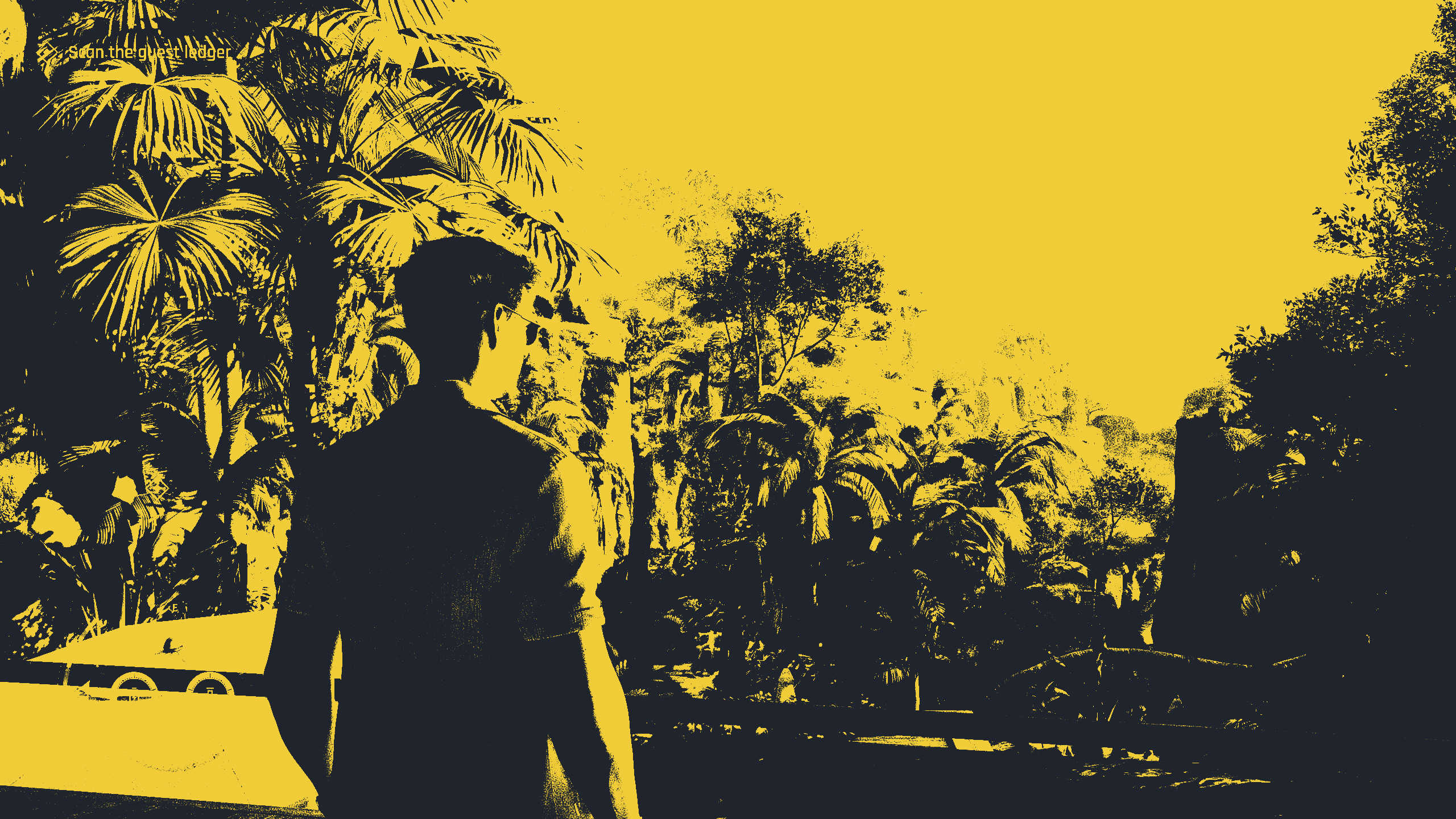
When I say that First Light is built for genre, I mean that every moment of the game feels like it is perfectly contoured over the model of the James Bond concept, folded and starched over the bodily form in ways that hundreds of professionals managed to accomplish over the course of several years. When I see the developing city emerge from the desert and the labyrinth of corporate managerial space capped with natural stone, I am prepared for genre to erupt at any moment.
In a previous era, there was a gamer’s fear of the chest-high wall. You came to a place, you saw the walls, and you knew that violence would take place there. The geometry signaled a usage—psychogeography of the digital world developed by magisters of vertices—and you’d hunt headshots or brutal melee kills in prestige formats.
Now that naturalism has come for all videogames that are not literal cartoons, genre could break out between any two given cinematics. An environmental puzzle might turn into a firefight. Stealth and combat are not two separate tracks any longer; they are two vibes in a glass-walled office, turned on and off when the designer needs the pacing of the game to change.
First Light is the first ur-game. It can be anything in the James Bond genre form at any moment, being neither a shooter game nor a stealth game nor an adventure game nor a prestige narrative thing because it has a world built for any of those things to happen at any moment. Built backward from cinema (in the same way that the Kojima projects since Metal Gear Solid V have been, although, also, in a different way), First Light signals that its spectacle could support any interaction you might want to have in it. James Bond is the sovereign individual outside of social relations, and he can be anything to anyone, the pure beast of capital’s jungle. He needed a game that could apprehend him. IOI delivered.
III.
First Light succeeds at being the kind of machine that it needs to be. I am deeply saddened that it, in turn, cannot be understood by its own masters. IOI has laid off developers after losing financing for a new, non-Bond project. Talented, deserving people are out on their ass. Similarly, whatever the fate of the studio proper, it seems improbable that it would be making the needed sequel to this game given that one of our media and tech conglomerates, Amazon, controls the intellectual property of Bond now and, seemingly, wants to take it in-house in a clandestine and foolish act of vertical integration. Efficiency with its firm hand on the wheel, I suppose.
Genre waves its head again because Bond is seemingly an active nothingness, an excuse to spend the money, an excuse vehicle that forces a logistics and infrastructure company into particular kinds of conversations and forms of valuation. Bond has always been an excuse to show beautiful locations and to fantasize about a specific kind of love (of the object; of objectification; of being objectified), and now the item being shown off is the line item of Bond (it)(him)self. The wonder of Bond is that he can circulate, dance like Marx’s table, with no history other than what we remember. He’s a set of skills centered on witnessing a valorized mode of existence in a given media cycle. When Bezos took over a city, powered by vectorial capital, he was pursuing the fantasy of the abandoned film set and the world where the extras have been banished off-screen for a little while. The world built for no one; a world built for Bond.
Bond is the man that can be anything to anyone. First Light is the game that could break out anywhere, at any time. The Bond IP extends as flexibility, and perhaps that’s why the post-Craig years are so caught up in development hell. What is Bond in a world where he has radically become nothing beyond a line item? He’s not the peak accomplishment of anyone any longer, just a brick in a tower building toward infinity, a form of existence antithetical to his entire existence. From the perspective of the fullness of Bond’s time, we might think of First Light as the last glare; the final time that Bond was Bond, recognizable, framed in the distance by the things we wanted to be, unsullied by what his new owners must inevitably make him become.
***
Cameron Kunzelman is a writer and a critic. His books The World is Born From Zero, on science fiction games, and Everything Is Permitted: On Assassin’s Creed, about the Assassin’s Creed franchise, are books you can buy. He podcasts for Ranged Touch.