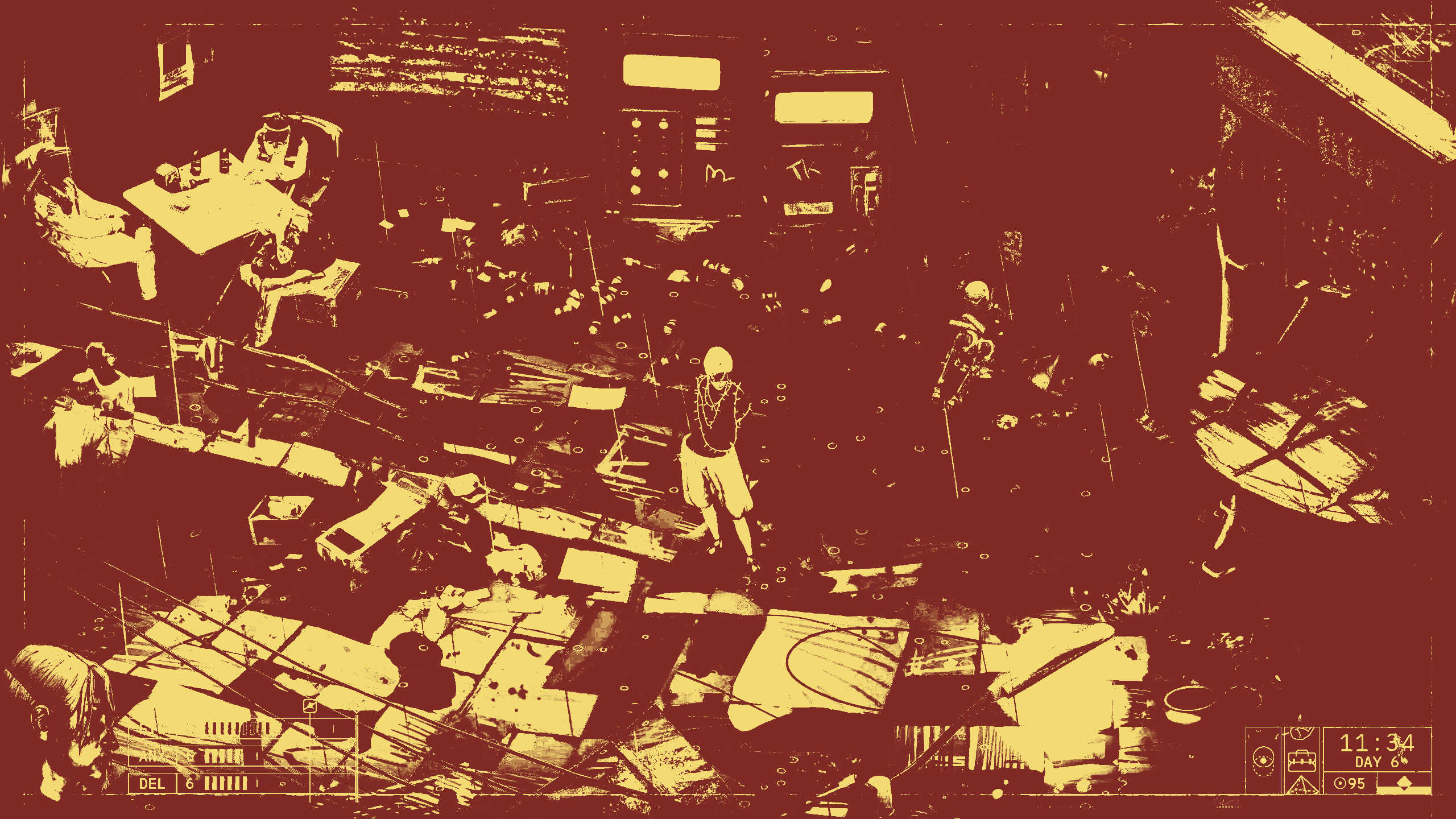
It takes less than 15 minutes for Zero Parades to announce that it’s a queer game. Opening her own file, protagonist Hershel Wilk reads that she has “unconfirmed homosexual tendencies.” The player is asked whether they’d like to confirm them or say they’re “a vicious rumour started by my extremely horny detractors.”
I chose the former, but unless the game is willing to near-immediately lock the player off from huge parts of Hershel’s interactions (and elsewhere it never seems to show much of a willingness to close down possibilities based on your choices) it’s clear that she is canonically attracted to other women. What’s not clear is that hypothetical detractors broadcasting this information to the world would actually have any impact.
Queer people are everywhere in Portofiro. Your former coworker Tempo has risen to become a local crime boss, and is also openly gay. His lover, Reno, is the CEO of the largest corporation in the city. There doesn’t seem to be any kind of discrimination or disgust; though the people Hershel flirts with often shut her down, it’s personal rather than structural.
In fact, sex itself doesn’t seem especially taboo on the streets of this struggling city. The Miracle Line is a phone sex hotline that operates 24/7 from a payphone in the Backways. One user is constantly hogging it, broadcasting his conversation to the world, and particularly to three old men who impatiently wait their turn while openly discussing their own kinks.
At first, this queernormative and radically open world feels strange. It appears to stymie some of Zero Parades’ ability to comment on its clear real-world analogs. For example, Portofiro was previously colonised by the techno-fascist empire of La Luz. In a conversation with an imprisoned La Luzian, Hershel can confirm that the empire hates “women and homosexuals.” That this attitude has been so thoroughly lost somewhere in the turbulent history of Portofiro is, initially, surprising.
But looking closer, the game’s use of sex dovetails with a different part of Portofiro’s history. After colonisation, the city went through a turbulent back and forth with the dictator Sweet Nestor. His initial ascent to power as a communist revolutionary might explain some of the openness about sex, if not queerness; leftist theorists since Engels have argued for greater sexual liberation, in narrower and broader ways. However, Nestor eventually rejected his previous politics in favor of “Nestorismo,” a scattershot totalitarianism that mainly emphasised Portofiran self-reliance.
But this ideological focus could not hold up to the encroaching pull of capitalism, and Portofiro ended up taking—and failing to pay back—multiple loans from EMTERR, the global investment bank that functionally both controls and exerts the power of all capitalist countries—the “Developed World,” in Zero Parades’ parlance. (If its political power isn’t clear enough from that description, consider that EMTERR stands for L’Empire Sans Terretoire.)
A successful roll will assess the guy hogging the sex line as having “perversion, Developed World variety.” From this, you can then glean he works for EMTERR. If Hershel considers the perversion and the capitalism inseparable, the game goes further. The EMTERR agent’s phone sex revolves around asking the operator, Duchess, to act as his mean boss. He talks about 80 hour weeks and being reported to HR (actually, HC, Human Capital), rarely even mentioning matters of the flesh. Later, when you tap the line, your old friend Rameses points out that “he can’t get off without thinking about work.”
Neither can you, apparently. If you use the Miracle Line, you also make it a work thing. You can put Duchess in the role of your handler or you can be the one in control, but either way the roleplay is spycraft; Hershel’s business. There is a single alternative, in which Duchess pretends to force you to become an augmentoid, Zero Parades’ little-explored cyborg analog. While I’m not sure if augmentoids are actually real in the world of the game, it’s impossible to evoke the robot without also straying back into questions of labor.
But these scenes surrounding the Miracle Line do not only speak to an overlap between sex and work. More specifically, they conflate sex and dehumanisation. The EMTERR agent doesn’t want to be a man, he wants to be Human Capital. Hershel, by virtue of being the player character, is given more choice, but all within the same thematic box: to be the faceless, impersonal handler; to be the identityless, order-taking spy; or to become an augmentoid. (Or, I think, to die resisting the latter.) Later, she might confess bits of her previous disastrous work failures to Duchess, shedding the boundary of fantasy entirely.
These two are not the only users of the Miracle Line, though. Eventually, you can find out what one of the old men waiting for the phone uses it for. A once-pilot, he imagines bombing the civilian city of his former enemy. “Cluster munitions. Blood. Shrapnel. Women pinned under rubble. Screaming.” Duchess provides said screaming, until her voice gives out. (This client thinks Duchess is his friend, and tries to give her a present for her children.)
Sex is labor is dehumanisation beyond the Miracle Line, too. The description on a La Luzian fleshlight you can strip for batteries implies that the techno-fascist empire leans heavily on artificial insemination, presumably related to its aforementioned hatred of women. And aside from Duchess, Hershel’s primary sexual interactions are (depending on player choice) assaulting her comatose colleague and a back and forth with an EMTERR interrogator. First, Hershel is subject to an erotically charged electrocution-based interrogation, and later, they go on a quasi date-slash-information sharing excursion during which Hershel can remote puppet the bartender into doing a better job.
Portofiro struggles with perversion, Developed World variety. Capitalism pervades everything, turning sex, like the city itself, into a site for the contestation of labor and human dignity. Under the weight of its history as a colonised city, a twice-over dictatorship, and the subject of ongoing propaganda efforts and accumulating international debt, Portofiro’s ideals have shifted and morphed. What was work is now intimate and what is intimate is now annihilation.
***
Jay Castello is a freelance writer, editor, and podcast host based in Sheffield, UK. If they're not down a research rabbit hole you'll probably find them taking bad photographs near a riverbank or old tree, but you can also try Bluesky, or their website.