The first piece of media criticism I remember reading that wasn’t a scored review was the The Final Word column in the July 1998 issue of Electronic Gaming Monthly. In the piece, Associate Editor Shawn Smith eagerly awaits the new Beastie Boys album (Hello Nasty) and admits that as a fan of their previous output, he both anticipates and would happily accept a new record that sounds mostly like the band’s prior releases in terms of style and subject matter. Smith positions this expectation in contrast to those for videogame sequels, which typically involve a desire for significant changes and marked technological improvements upon their predecessors. He runs through a quick list of reasons why this discrepancy might exist but ultimately settles on a charge for readers to question the standards they hold game sequels up to.
Is this the deepest insight? Perhaps not, and in fact it could be interpreted as letting corporate cash-grab sequels off the hook. But given that if these off-the-cuff musings were written today, it would probably take the form of a threaded skeet or something, I don’t believe Smith’s column was ever meant to be the totality of thoughts on the matter, just a notion to consider. For personal context, this was the summer before I began freshman year of high school so imagine an inflated profundity to the whole thing.
Still, I find myself returning to Shawn Smith’s question on the merits of repetition as I’m reflecting on my time with Castlevania: Belmont’s Curse, the latest in an extensive train of franchise sequels. It’s not just the “style” (Smith’s term) of Castlevania games that gets repeated, but entire gameplay rhythms. Most Castlevania games begin outside Dracula’s castle, then proceed in as players explore the depths and heights of the fortress, including a penultimate stop at the clock tower, fight Death, fight Dracula, The End. On paper, it seems crazy that they’ve gotten away with making 40 of these, but I find an appeal in seeing how Castlevania’s core facets are altered and adapted to each game’s unique premise.
In music there’s the concept of a “variation in production” or “VIP.” I’m mainly familiar with the term in electronic dance music genres where the idea is that the producer basically remixes their own track, often largely using the assets used to build the original version. Tonally and structurally, a VIP has potential to diverge wildly from the initial recording. There are millions of examples out there, but here’s a two-track VIP release by Kloke and Tim Reaper based on their collaborative track “Foundation” from three years earlier. On this release, the jungle producers each take on making their own VIP of the base tune. Kloke’s is more space-y and atmospheric whereas Tim Reaper’s has a darker edge and tumbles into staccato high hats that shoot the track out through a machine gun. After listening to the VIPs, aren’t you curious what the original sounded like?
That curiosity is how I wound up playing all the Castlevania games this year. On a macro level, it was out of an impulse To Know. On a micro level there is a carnal clubgoer indulgence in whipping skeletons, dodging scythes, and breaking walls to reveal shanks of meat in different settings and with different characters.
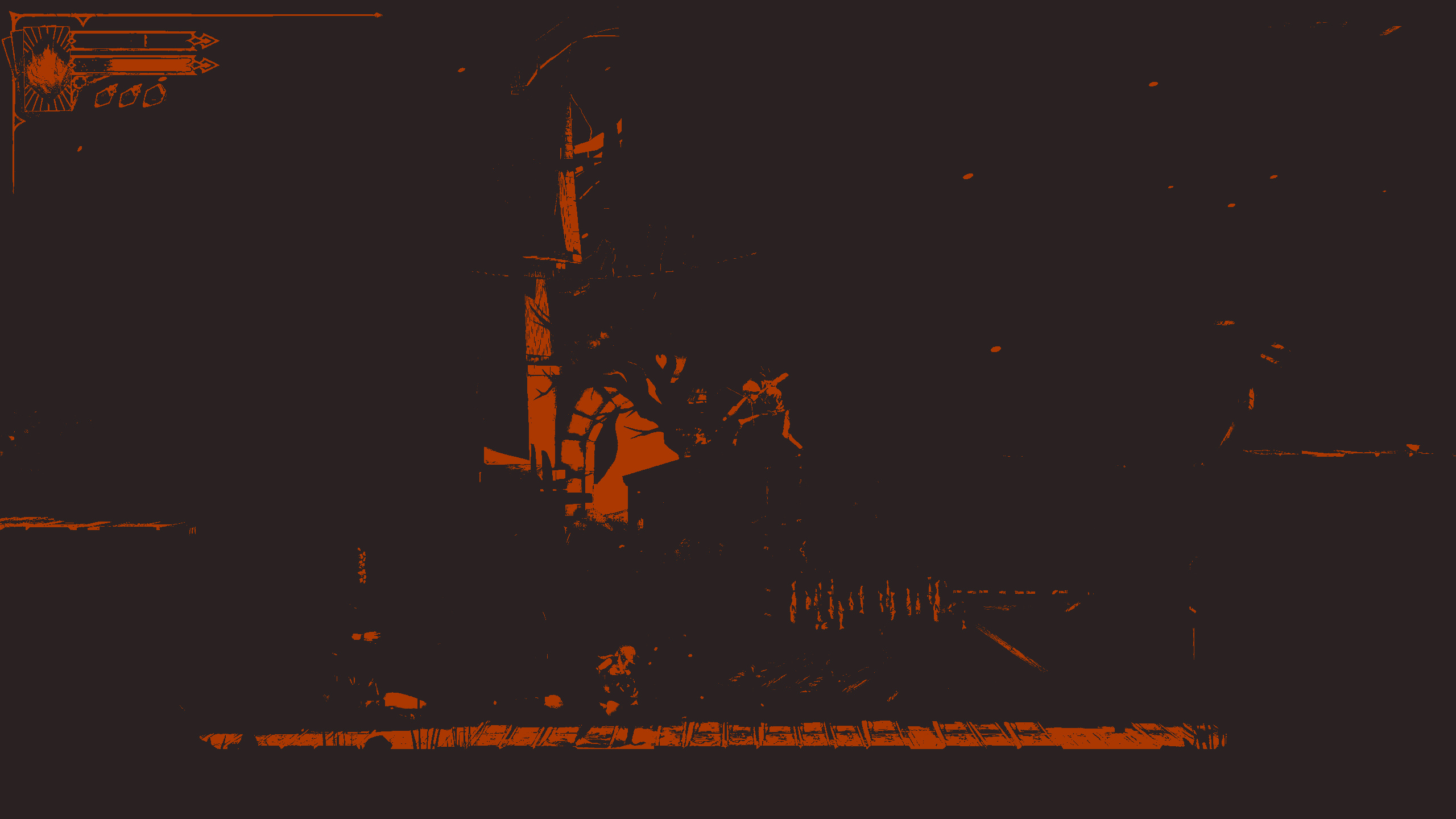
Belmont’s Curse doesn’t feel like an endpoint to this continued practice, but it does act as a kind of culmination, a VIP of the entire series rather than just the original game. Cryptic notes from NPCs that hint at where to go next à la Simon’s Quest? Check. A parallel dimension you enter through a corrupted save point like in Symphony of the Night? Yep, it’s there. A “true ending” that can only be achieved by triggering an ultimate attack at the end of a final boss fight as in Order of Ecclesia? You got it. It’s an impressive feat that, unlike some of the recent officially-licensed DLCs that build out Castlevania extensions for those games (Vampire Survivors, Dead Cells, etc.), Belmont’s Curse’s use of these mechanics doesn’t come off as a winking reference but, instead, a repurposing of old tools in new ways.
The Parisian setting goes a long way in this framework, staging the usual monster slaying haunts in locations with real-world analogues like the Holy Innocent’s Cemetery and Notre Dame Cathedral. It’s the most compelling grounding for a Castlevania game since Portrait of Ruin. Belmont is a French surname after all, so this is a bit of a homecoming.
The underground catacombs, again with a basis in the real-world Parisian locale+, is a prime example of how Belmont’s Curse refreshes classic Vania staples; walls are lined with skulls, spooky music, lots of skeletons to fight. That’s all in Belmont’s Curse too, but the number of secret breakable walls is much higher than other biomes, which reiterates the ancient, brittle, and cheaply sealed-over quality of the tunnels. In some low-light corridors, enemies appear only in silhouette with glowing red eyes, making them seem more unpredictable in their visual obscurity. Booby traps drop fire-breathing bone pillar enemies to surround you, which feel like actual snares someone in this world would lay out for trespassers. Yes, you can still find rooms of swinging axes and oscillating buzzsaws, but on the main path, the hostile architecture feels less divorced from real world logic than Castlevanias typically are.
Focusing in on these details in Belmont’s Curse, like the novel integration of the stopwatch time freezing effect (traditionally a sub-weapon item that you can find anywhere) into the clock tower itself, is, I realize, an emphasis on genre details more so than the overall gestalt of the work. But I’d argue that the more you examine the minutiae of Belmont’s Curse, the more you do get a sense of the total picture. The Castlevania games have always been steeped in genre, both in the videogame form of action-adventure tropes and in the way they borrow heavily from a smattering of public domain horror fiction. This patchwork of Universal movie monsters and pulp mythology woven into unabashedly game-y systems elicits a campy charm that ultimately solidifies mashup and adaptation as core facets of the series’ DNA. It’s not surprising then that Castlevania (1986) director Hitoshi Akamatsu originally chose the whip as the main weapon because he thought it looked cool when Indiana Jones used one.
The VIP and the genre exercise go hand-in-hand as both are bound by specific creative parameters and have an implied sense of experimentation to them. When you consider Castlevania exists as a genre unto itself at this point (more than 4000 games are tagged with “metroidvania” on Steam), doubling down on creative reuse of the series’ mechanical nuances is about as true to form as you can get.
I don’t know if Belmont’s Curse would have passed 1998 Shawn Smith’s sequel quality test, but I do think it’s a case where “style” and “substance” are more or less the same thing.
///
+The game’s 1499 setting predates the establishment of the Catacombs of Paris.
***
Dan Solberg is an interdisciplinary artist, curator, educator, and freelance writer/designer living in Kentucky. To view his portfolio visit: https://dansolberg.com/