This article discusses plot details from throughout Virtue and a Sledgehammer.
There’s a constant temptation, made easy with the affordances of modern life, to just check out from everything—to scroll, to watch, to listen, to desaturate the torrent of thoughts by giving in to the flow of distraction. Videogames are one of the most numbing of these temptations. At their worst, they offer seductive facsimiles of accomplishment and physical movement, sometimes obscuring a hamster wheel of repetition by draping the bars of that wheel with images of shallow wonder. The colours are bright, the technical accomplishment of digital art worth staring at, the pop of numbers promising a feeling that something is in the process of becoming.
This is a negative way to look at the possibilities inherent to interactive art, but it’s one that becomes hard to avoid when you spend a lot (too much) time with videogames. In its mainstream especially, viability involves creating products for the median consumer. It looks like the cold efficiency of reduced headcounts and minimized risk. When Silicon Valley offers a new technology, videogames, common knowledge says, must embrace it or risk a loss of competitive advantage or, more directly, profit. Entropy takes the form of vibe coding, image generation, and predictive text storytelling. Averages round out the edges, and the proponents of content emerge triumphant.
There’s a part in Virtue and a Sledgehammer, a game by Selkie Harbour and Deconstructeam, where the protagonist Pratelle picks out eyeliner. She’s not used to makeup in general and her sister, Nina, guides her towards a good choice. The blue Pratelle tries on doesn’t look right. She wipes it off and goes for another option. Red ends up being more her colour.
Virtue and a Sledgehammer is filled with bright reds. The screen floods with it to mark a scene change. Memories from Pratelle’s past appear as floating red glass sculptures. The lights that glow from computer terminals are red. The textbox that marks her dialogue options is backgrounded with a red rectangle. She wears red overalls.
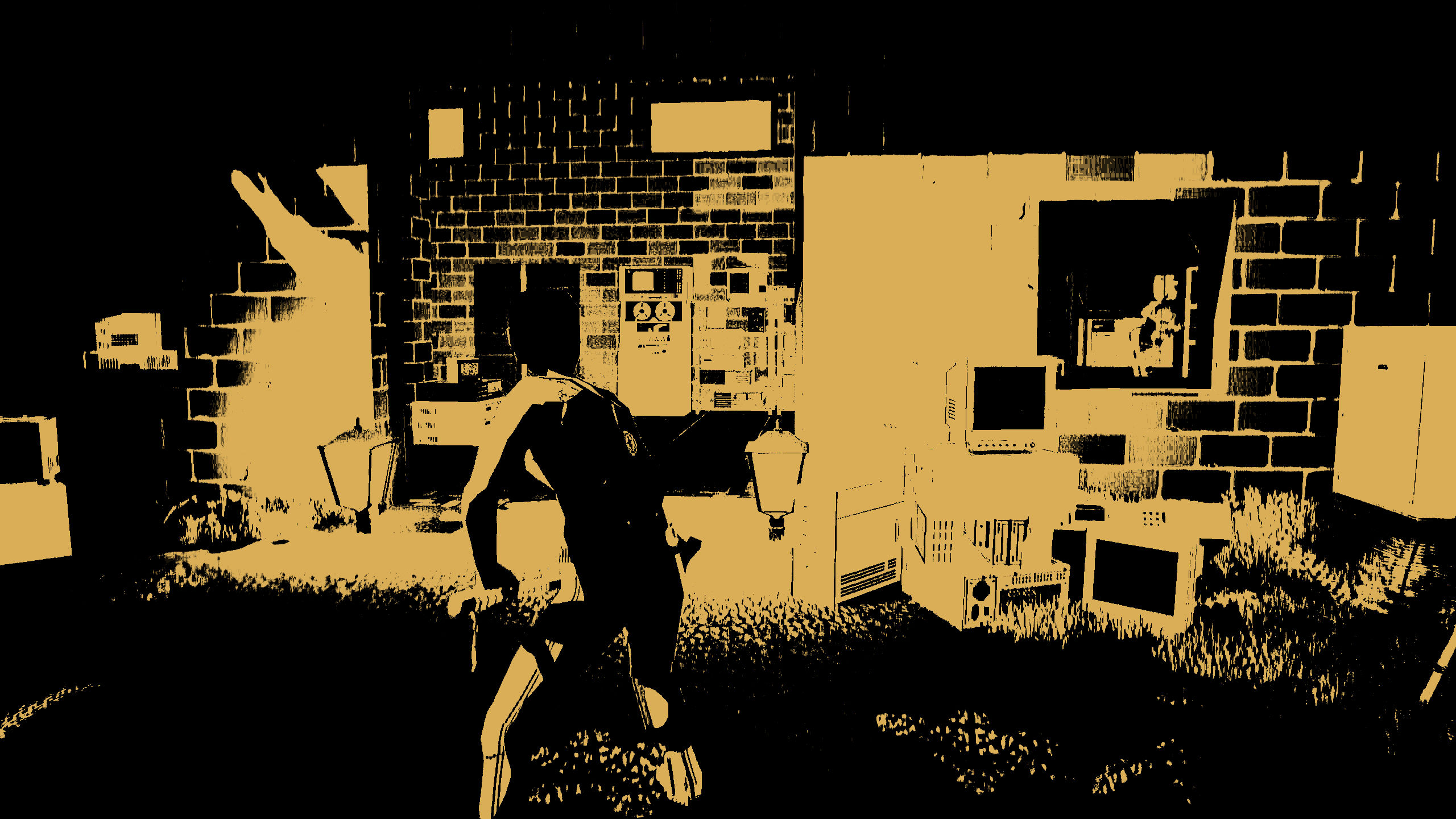
The two ways you interact with the world of Virtue and a Sledgehammer are by picking conversation options from a list of sentences and by using a sledgehammer to smash through the environment—a dreamlike town in rural Spain called Virtud. In the game, Pratelle’s sister Nina has accomplished a technological breakthrough, and robots, their synthetic personalities cloned from the now-dead former residents’ brains, populate her hometown. A button prompt asks Pratelle to raise her hammer and swing it down “to deal with your pent-up rage,” which she does, over and over again on a tour through images of her past.
Robots stand in the doorways of bars and restaurants, sit on couches and beds inside houses, and crowd the interior of a church. They talk to one another, sharing gossip and political opinions. They talk about Pratelle’s family: her supposedly Arab father who didn’t stick around to raise his kids; her sexuality, inferred by her buzzcut; her mother’s worsening dementia; and her sister’s success as a scientist. Pratelle can smash them all, whether they attack her or ignore her or plead for her mercy. When she finds the servers that house these neighbours’ data, Pratelle can break them, too. At the moment of their obliteration, a real-world photo of a moment from their lives—a birthday party, a communion celebration, a view of a back garden—flashes onscreen. When Pratelle is hurt by the machines, the world desaturates and turns red.
It would be too easy to read Virtue and a Sledgehammer as a game entirely about the soul-sucking phenomenon of AI. The robots are facsimile people whose vapid but deeply personal statements reflect the same aggravating mimicry of personal pronoun-using text generation algorithms, like the paragraphs barfed onto the top of current Google search results. There’s a thread of debate between Pratelle and Nina about what constitutes a “real” person, and of what’s left out when brain activity and behaviour is replicated by lines of code.
But Virtue, to its benefit, is invested as much in human drama as the above topics. Pratelle’s red-hot rage is directed at her sister’s work to digitize the town—and their mother—into androids. She’s angry at the insult of Nina’s rival philosophy of life, one that sees sophisticated technology as close enough to human life that the distinction no longer matters. There’s texture to this that goes beyond what a (admittedly cathartic) game about taking a hammer to abstracted forms of AI might suggest, though.
A computer monitor—the first object Pratelle can smash in the game—reads, “I wish you could experience life without pain.” The heart of the story is encapsulated in that sentence. Pratelle is furious because she loves her sister and violently disagrees with her efforts to smooth the wrinkles of human existence out into a flattened utopia. Their common childhood is defined by struggle. Flashbacks show them talking about how to care for their mother as she mentally declines, and of the difficult commitment required in loving a parent who treated you poorly as you grew up. They talk about romance and sex and thwarted ambition, of the provincial ignorance of neighbours and of what personal happiness might look like. The accumulation of these details builds a foundation for why that sentence on the monitor is worth fighting against. Pain makes life what it is. To defeat it means erasing the counterpoint of suffering. Joy can only really mean anything in contrast with its opposite.
There’s discomfort in how all of this is presented. Pratelle and Nina’s relationship—and their relationship with their mother—isn’t easy to summarize. The family loves one another even as they hate each other. Pratelle and Nina are cruel. They’re loving, too. They truly want to know what each other thinks about deep moral questions, but they disregard the answers they find. Rather than offer a tidy morality play, Virtue and a Sledgehammer asks its audience to sit with the uneasiness of loving other people and despising them at the same time. (The pause screen provides a constant reminder in a line of text hovering over menu options: “I still love you more than I hate you.”)
In a lot of games, the satisfaction of smashing things is the whole point. Erase the enemy by pointing a gun at them. Wreck a building by driving into it or tossing an explosive at it. In Virtue and a Sledgehammer breaking things is a flashbulb that illuminates what is broken. Pratelle reduces a house to rubble, and the absence of the house becomes bigger than its former presence. The robot that cowers as she rampages is mannequin still once it’s been killed, a weightier object than it was when it was still living. Violence is constructive, if it’s directed towards the right target. Pain can be revelatory.
All the red that colours the game ends up looking a lot like blood. It helps make the case, both within the game’s story and in the larger context of the medium it’s a part of, that our entertainment and art don’t mean much if they don’t bleed a little bit, and maybe make their audience bleed a little bit, too. Blandness is a slow death. It’s a comfortable distraction. Virtue and a Sledgehammer is confrontational, narratively thorny, and, as a result, far more alive than most videogames.
***
Reid McCarter is a writer and a co-editor of Bullet Points Monthly. His work has appeared at Kotaku, The AV Club, GQ, Kill Screen, Playboy, The Washington Post, Paste, and VICE. He is also co-editor of SHOOTER and Okay, Hero, co-hosts the Bullet Points podcast, and posts on Bluesky.