This article discusses plot details from throughout Tenebris Somnia.
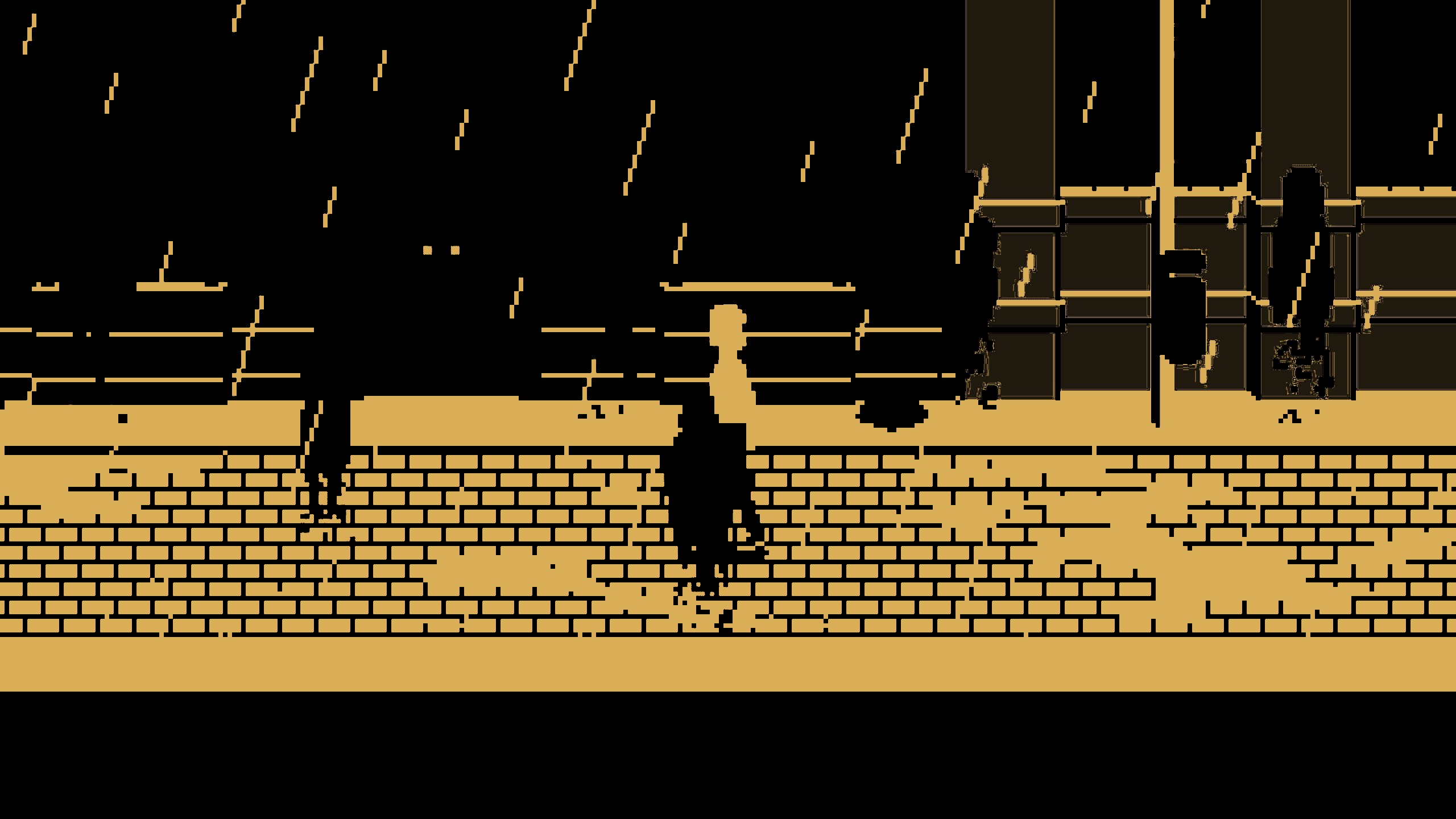
When I was playing Tenebris Somnia, although the FMV sequences—naturally—had real actors, ‘real’ sets, and gore effects designed to mimic real internal organs, I was a lot more frightened during the (playable) 8-bit sections, the parts that look like a videogame from the '80s. There’s a neat little duality thing going on here. In the first half of the game, the protagonist, Julia, is beguiled by a magical spell that alters her memories of her ex-boyfriend, Iván. When the spell is lifted in the second half of the game, she suddenly remembers Iván—and their relationship—as it actually happened. Examine the canisters containing Iván’s prize-winning short film during the first half of Tenebris Somnia and Julia will say something about how great it is. Return to your inventory and examine the same canisters again in the second half, and she’ll describe how cruel and impatient Iván was with her on the day of filming.
It might be obvious or simplified, but I like how the swap between FMV aesthetics and form and 8-bit-videogame aesthetics and form means there are two versions of Julia’s story literally. It also creates a kind of interplay between clarity and abstraction. Julia’s memories are initially false and augmented but later they become clearer and more truthful. We see blocky approximations of people and places then cut to those same people and places captured in the more defined, more verisimilar, more ‘objective’ format of photography. The story of Tenebris Somnia involves a lot of jumping back and forth between different apprehensions of reality. So does its aesthetic.
But this isn’t why I found the 8-bit parts scarier than the FMV ones. I kept going back to that thing that horror game developers and horror filmmakers say, where what we’re most afraid of is what we don’t fully understand or see. ‘You’re scared, I pull open the closet door, and argh! It’s a 25-foot cockroach! But if I never pull open the door, it could be a 30-foot cockroach!’ I think this is part of the explanation. I think it’s why, for example, old Resident Evil gets under my skin more than new Resident Evil. Rendered in four billion polygons, a giant monster with teeth and tentacles will always remain a giant monster with teeth and tentacles. But if you cut some of those polygons out, you make space for conjecture, imagination, and interpretation. I mentally add more tentacles, more teeth, and maybe a thing that spits acid as well—left to my own internal devices I make the cockroach five feet taller.
But that’s not entirely it either. And I actually don’t like that explanation for why certain things are more frightening than others, probably because I’m a bit of an elitist or a purist or something, and I kind of get off when artists say ‘no, this is what it means and this is what I meant and this is my vision’, and they don’t take into account how an audience might react at all. In the same way you get an Oedipal complex if your mum doesn’t pay enough attention to you, because I never hear game makers say stuff like this—like ‘this is what it is and this is my art’—I suppose I’ve ended up fetishising the idea of the player-uninterested game developer noble; the unapologetic auteur-sadist. After so much ‘we want the player to tell their own story’ and ‘we love seeing the different ways people play our game’ and ‘we didn’t want to force any specific message on people’ and credits that end with ‘to all our players, thank you’, I sometimes long for not only the opposite but the opposite in extremis, a game where the affection between developer and player is nil, or as close to nil as it can be.+
So I don’t want to say the 8-bit parts of Tenebris Somnia are scarier because they allow for more interpretation on the player’s behalf. But I think it is true that the FMV parts are less scary because they look more real. Of course there are gradations, but generally speaking I’m not sure that fidelity is frightening. The whole psychological process here feels a bit tied up and strange, but it’s something like this:
—When I play or watch horror I want to be scared
—But even the most willing suspension of disbelief can only extend so far
—At some fundamental level, we all know that monsters, ghosts, whatever the subject might be, aren’t real
—So when there’s an aesthetical effort towards realism and making these things appear at all real, at some irresistible, instinctual, un-fun rational brain level we reject it. Reid wrote about this in our Resident Evil 2 issue.
—If we’re more afraid of what we don’t understand, anything that is rendered, styled, designed, photographed, filmed, etc. in a way that attempts to make it look like it belongs to our own corporeal reality will be less frightening than something that doesn’t
—Or, artifice can be more frightening than believability. Freddy Fazbear is scarier when he’s a stiffly rendered 3D cartoon than when he’s an expensive animatronic filmed in 4K resolution. When something looks like it doesn’t belong to the proportional, dimensional, and definitional rules of our world, it defeats that defense mechanism where we can tell ourselves it’s harmless because we know nothing like that exists in our reality.
After Tenebris Somnia I played Silent Hill 3 again and this time around I really noticed the noises the monsters make. It’s parts like this. Or this. It’s not the sounds themselves so much as the fact that they repeat so quickly, like the audio files—insane_cancer_bark_01, or something—are really short. Hearing those same clips repeat and repeat, it makes the monsters sound fake; unreal; non-real. When you hit or shoot them, they’re like wind-up toys that have fallen on their side. I don’t think it’s any great revelation that Silent Hill has this aesthetic of fakery. Conceptually, the town is a kind of great, dreadful escape room built for one person. It wants to torture the protagonists some, but they also often (although not always) emerge from that torture as people changed for the better.
There’s monsters and terror, but the town will also provide a torch and a gun—and you don’t find those objects incidentally; they’re presented to you in showy, psych-profile-specific dioramas, like the mannequin with Mary’s clothes on or the storeroom in the mall where you have to turn out the lights. The town helps you, and wants you to know it’s helping you, and actually that adds to its malevolence. It’s like the bedroom, as described in Kitty Horrorshow’s Anatomy: “Less like a mind and more like a mouth. It is here that we place ourselves most at the house's mercy and spend each night hoping that it will not bite down.” It’s scary because it seems so entirely focused on you, and determined and able to move you in a specific way, towards a preset place. Another image from Silent Hill 3: the Otherworld, with its fleshy tarpaulins, skeletal metal grates, and impossible sky-to-ground screen doors becomes a kind of cosmic backstage, complete with grips and focus pullers. Designed, laid out, and deliberate, the nature of the reality of Silent Hill is a total inversion of actual reality, which almost always appears chaotic and random. It’s this bizarre paradox where because you can discern a patent element of creation and intent and forethought—and an artifice—it actually feels much more dangerous, because those things just don’t exist to that degree and that explicitness in our own reality.
Coming back to Tenebris Somnia, if not so much in its pixel-art visuals, you can feel this in its architectural layout and puzzles—the way it’s so patently built around the back-and-forth retrieval of keys, and everything slots together. If what we fear the most is what we don’t understand, this kind of cohesion is unnerving because it’s so beyond the ‘rules’ of our own reality; a sense of direction, and of being directed, to this extent is both highly alien and creates a sense of a potentially malignant overseer. Maybe that’s why the final boss in Silent Hill 3—the repulsive entity that is ostensibly steering Heather Mason towards a union with it—is simply called ‘God’. When Heather kills it, she does so to escape from the uncanny nightmare of its constructed world.
///
+This might be why I like Escape From Tarkov.
***
Ed Smith is one of the co-founders of Bullet Points Monthly. His Bluesky handle is @edwardsmithwriter.