In a 1973 interview with the Chicago Tribune, Francois Truffaut said “there’s no such thing as an anti-war film. Every film about war ends up being pro-war.”
When you endeavour to generate enthusiasm about war from your audience, which you naturally have to do if you’re making a film, you lose something of war’s real nature. The problem might not be about making on-screen war entertaining, but more attempting to impress a narrative upon a representation of war. When we make something into a story, we make it make sense, and when we make something make sense we’re also suggesting that it has implicit reason. But the reality of war normally supersedes reason. It obliterates reason. If you try to shape it into a tale, you inevitably disguise the reality of the encompassing devastation of war, which cannot be explained in terms of logic or morals. Two of the greatest works of anti-war art, Pablo Picasso’s Guernica and Jimi Hendrix’s rendition of the "Star Spangled Banner", are ‘successful’ as anti-war artworks because they deliberately deform the conventions of their construction, Guernica in its extremism and absurdism (as opposed to realism or naturalism) and the "Star Spangled Banner" in its spontaneous, unpredictable deviations from the music as normally deployed in its official capacity as a national anthem. They ‘work’ as anti-war texts because, like war, they appear to the beholder as ungoverned and ungovernable, and their defining characteristics are their respective disfigurements of code.
If a rudimentary narrative is composed of a villain with an immoral goal versus a hero with a moral goal, fighting one another using equal bestowments of strength, World War II is the closest there is to a narrative war. A lot of wars since then, and especially in the 21st century, don’t meet the criteria for basic narrative, or only meet it if you are predisposed to a crudified version of—usually western colonial—morality. Wars in the last 30 years have instead become almost entirely non-narrative, or what Frank Hoffman called in 2007 ‘hybrid wars,’ that is wars with “a non-standard, complex, and fluid adversary” fought using “a combination of conventional and irregular methods.” Forget moral meanings, we don’t even know what a war is now. This is why today’s war videogames are always about the team rather than the war. You can see this creeping in in Call of Duty: Ghosts in 2013, and then it becomes gradually more defining throughout Advanced Warfare, Black Ops 3, and Infinite Warfare, and then even more so in the trilogy of Modern Warfare rebootmakes and in Black Ops 6. The atomisation of CoD’s narratives, wherein we shrink the focus onto a small group of individual soldiers and their personal stories, reached an apotheosis in this year’s Black Ops 7, where you play as a multinational team of special forces operators trying to capture the CEO of a rogue corporation.
Although the team is called Joint Special Operations Command, which in reality is a branch of the United States military, in the game they don’t fight on behalf of a national ideology so much as plain and morally flat ideas like freedom and stopping innocent people from being killed. The rogue corporation in turn doesn’t represent a country or society, or an ethnocentric or geocentric belief system. Its targets are everybody, everywhere and its headquarters are in a fictional and independent citystate, which it owns. These contrivances of world-building mark a concerted effort by the makers of Call of Duty: Black Ops 7 to decouple the game from the real world and in doing so safeguard it against observations of ideological bent. This is possibly because the makers feel that implications of reality are antagonistic to fun and that it’s easier to sell the game to people all over the world and across the ideological spectrum if the game is neither part of the world or the spectrum.
But this also betrays a perverse (and almost certainly inadvertent) timeliness, because the more that the concept of the hybrid, non-linear, forever war has taken hold in our society, the more the Call of Duty series has stopped trying to make conventional sense or structure out of its fictional wars in kind. In 2003, the year that the war on terror formally began in earnest, the first Call of Duty game was released. It’s a World War II story that focuses on different soldiers from different armies from different countries, united of course in a battle against Nazism and the Third Reich. These characters are essentially nameless and voiceless sets of hands and a rifle, defined by their nationalities and locations: the American campaign, the British campaign and the Soviet campaign. 22 years later and the global war on terror, the ‘GWOT’—ever amorphous, and morally and temporally indefinable—has rearranged our general concept of war to the point that a moral adventure fought on ideological or nationalistic grounds no longer seems either real or plausible for fiction.
This reconfiguration of war’s definition, or rather, the deterioration of the idea that war might be given a definition, has occurred alongside the onset of the “postmodern condition” prophesied by Jean-François Lyotard. Lyotard describes both a loss of faith in the unifying metanarratives that consolidated modern societies and a commensurate rise of a “plurality of small, competing narratives.” At its most extreme conclusion, this results in a paradoxical society where the only ideological consistency among its members is that they all reject the possibility of there being a shared belief. It’s a western world where, alienated and marginalised by the failure of modern ideas, people turn ever inwards and fight metaphorical battles in the name of the self rather than literal ones on behalf of the state, the church, ethnicity or isms. If Call of Duty: Black Ops 7’s broader setup (military unit without strict national or ideological identity versus corporation without strict national or ideological identity) is a reflection of the 21st century’s non-linear and non narrative wars, the postmodern condition is symbolised by the game’s other main design conceit, whereby all four of the central characters are infected by a neurological toxin which makes them hallucinate monsters symbolic of their innermost fears. Several levels in Black Ops 7 take place inside the characters’ respective imaginations, where they fight living, breathing and heavily armed personal demons. The postmodern alienation hypothesised by Lyotard, where people lose faith in bigger ideas and beliefs and retreat into themselves, takes literal form in the world of Black Ops 7, where soldiers without a country or ideology are left with only themselves to conquer.
Black Ops 7’s multiplayer implies a similar kind of inwardness, or a chosen withdrawal from the wider sociopolitical world. Matches are typically fought in small teams of six players versus six players, on maps that only make architectural sense in the context of a competitive videogame. Although some of their iconography and imagery is borrowed from real locations, they are constructed like arenas, rings or pitches, informally divided into sections that facilitate different approaches to play—rather than a strip of white paint to denote a field goal line, you may find a small balcony overlooking a street, delineating that this is an area built for verticality and scoped weapons.
One match type in Black Ops 7, named Overload, is a version of Bulldog, where one team of players has to collect a ‘ball’ and escort it from one part of the arena to another, while the other team tries to stop them. The game is strictly divided into two halves—after playing a certain number of minutes, the game freezes, there is a pronouncement that the match has reached “half time” and the two teams swap sides, so that the one that began the game attacking west to east now attacks east to west, and vice versa. Also similar to sport—or television broadcasts of sport—every match in Black Ops 7 ends with a slow-motion video of the “best play,” normally a clip of a player killing a large number of enemy players inside a short period of time.
Like the various pretenses of the single-player campaign, the presentation of Black Ops 7’s multiplayer has the effect of separating it from suggestions of the context of war, even though each match is still fundamentally about two opposing sides fighting one another with weapons. The ‘sportification’ of its structure and aesthetic is also reflective of the existence of the forever war, in the way that sports are played, replayed and replayed–new year, new season, new league, new cup. Both Autumn and Yussef describe this in their articles on Battlefield 6, how the repetitive and transient nature of online multiplayer feels increasingly apt in a world of endlessly recursive, impossible to quantify non-linear wars. This impression is perhaps more manifest in Black Ops 7, where the representation of people killing people is made so expressly sportlike that it becomes symbolic of the most cynical justification for the forever war: that war is only a game.
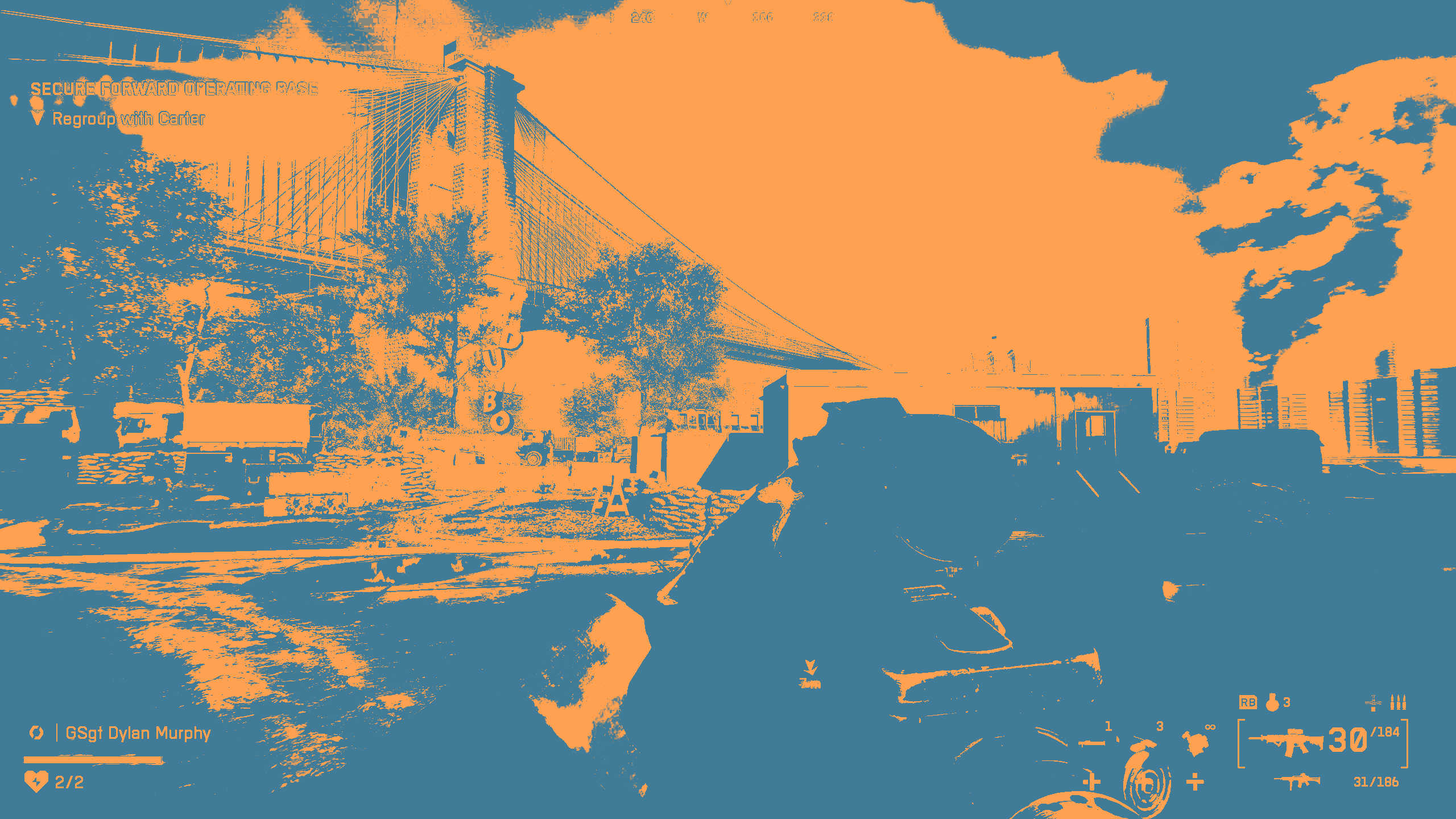
Battlefield 6’s campaign is spiritually similar to Black Ops 7’s, insofar as both represent a shifting in focus, away from the subject matter of war and its attendant thematic baggage, and towards the comparatively simpler and less precarious narrative topic of the team, and the struggles of the team. Reid has written about this for this month’s issue and he convincingly argues that if there is reluctance or nervousness among game developers to engage with (or rather re-engage with, if we account some of the older Call of Duty and Battlefield games) the knottier questions inherent to making war art and entertainment, then that’s unlikely to change any time soon. Battlefield 6’s multiplayer however can be equally evaluated as a deliberately constructed text. Though it is not ‘written’ in the manner that a single-player campaign is written, or directed in the way that a film may be directed, or painted, or composed, or so on, every one of its elements has been purposefully designed and amalgamated. It is a ‘work’ so much as anything else may be considered a work. The fact that certain questions of videogame criticism have historically not been applied to multiplayer games, and that we are used to evaluating them as games in the strict sense, that is, with our focus almost entirely on their ludological components and not on elements like aesthetics, plot, pace and meaning, is perhaps the main barrier to considering in this case Battlefield 6’s multiplayer as a war text, in the same way that its single player is a war text. Get past that and certain characteristics of Battlefield 6’s multiplayer distinguish it when we’re considering our credulousness towards narrative wars in reality and narrative wars in fiction.
The absence of a narrative—and the abundance of chaos—are key to Battlefield 6’s multiplayer. If what we find so difficult to accept with regards to supposed anti-war artwork is that it might impose onto war a temporal and narrative structure, Battlefield 6’s multiplayer does not really impose a structure. There is no heroism in Battlefield 6, in the constructed, romantic sense—no matter how valiant your in-game intentions may be, it is perfectly likely that you will be killed, unceremoniously and without dignity, before fulfilling them. When even the most bitter and undeserved defeat is expunged from existence with the beginning of a new match, there is also no tragedy. The war raging in Battlefield 6’s multiplayer is indefinite and without history, and there is no director, commander or God authoring moments of either individual valour or national anguish. The two sides have names but they are deliberately formless—one way to distinguish opposing armies and their respective ideologies in turn is through their weapons, like the NVA soldier with his AK-47 and the American GI with his M-16, but in Battlefield 6, both forces have the same guns, gun modifications, vehicles and equipment. Each game mode is an invitation to either capture or defend territory, but regardless of your success (or failure), when you begin a new match, all that ground that was won or lost will be reset to a default position, and that default position will again serve as an invitation for battle.
This is also true of other multiplayer war games, Black Ops 7 included. But the effect of Battlefield 6 to encourage analysis alongside Truffaut, Lyotard, postmodernity, and the existential panic of the forever war is enhanced by its visual and audio design. It looks and sounds warlike, which is not the same as realistic, but instead describes something that is capable of generating within you the feelings you’d imagine having in a real war situation–the loud explosions and gunfire, and the general hecticness of Battlefield 6, are likely to spark panic, excitement and aggression. But that ‘warlikeness’ in turn emphasises the absence of conventional ‘warness’ elsewhere in the game. We are made to feel like this is a convincing simulacrum of a war. We are also aware of its structurelessness, its narrativelessness and its ultimate absence of logic or moral meaning. Battlefield 6 starts to shed light on the ironic truth of postmodern war, where the only thing that is tangible and true is that very little, and perhaps nothing, is true or tangible. If war is capricious and cruel, thoughtless and amoral, and never achieves anything and doesn’t change, that is also the war of Battlefield 6’s multiplayer.
But therein lies more irony, because Battlefield 6, by design, is a game where no meaning is available to us other than the meaning that we make for ourselves. You may play it and feel like it is a convincing anti-war text or an illustration of some characteristic of 21st-century warfare, but although it has perhaps been constructed to produce that impression to an extent, there is ultimately no encompassing, overarching meaning being imposed on the game and its players—what is keenly felt is an absence of meaning, rather than an abundance, or even a presence, and so the game still feels subject to that postmodern condition, where our lives are defined by indefinition. Truffaut said an anti-war film is impossible. He also said that every war film inevitably becomes a pro-war film. Battlefield 6 feels anti-war because of its dearth or deficiency of meaning. It is full of emptiness. And contrary to Truffaut, who was speaking in the ‘70s—the modern era—before the collapse of the Berlin Wall, the rise of the internet and the endless GWOT, that does not make it a pro-war text. Battlefield 6’s ‘anti-warness’ results from a lack of structure and a predominance of disorder—from a kind of anti-meaning. In that, rather than pro-war—or anything-war, or anything—it becomes another reflection, or byproduct, or cultural symptom of the void of meaning that has now become war’s defining characteristic.
***
Ed Smith is one of the co-founders of Bullet Points Monthly. His Bluesky handle is @edwardsmithwriter.